Hekate Kleidoukhos

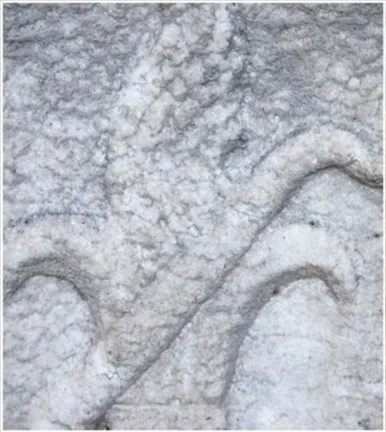
Image of a torch and key motif found on a column at the Temple of Hekate in Lagina. Photo from Anatolian Archaeology, photographer unknown

This post is part of a series regarding Hekate’s epithets, and the full list may be found here. This is a work in progress.


“Kleidoukhos” (sometimes spelled “Kleidouchos”) is one of Hekate’s more well-known epithets, and it translates to “Keeper of keys”. In ancient times, the role of “Kleidophoros” (Key-bearer) of the temple was an important one; the key that the priestess (or priest) carried signaled the authority that person had over the temple and sanctuaries, and the duties they were responsible for as guardian of this sacred space. Besides the obvious need to protect valuable artifacts (such as cult statues) and money within the sanctuary, keys have a metaphorical / symbolic meaning beyond the mundane demands of security.

The Orphic Hymn to Hekate, dated to about the 3rd century BCE to 2nd century CE, first mentions Hekate as Kleidophoros. I am sharing the more well known translation by Thomas Taylor below, as there are many translations out there:

“Hekate Einodia, Trioditis [Trivia], lovely dame, of earthly, watery, and celestial frame, sepulchral, in a saffron veil arrayed, pleased with dark ghosts that wander through the shade; Perseis (daughter of Perses), solitary goddess, hail! The world’s key-bearer, never doomed to fail; in stags rejoicing, huntress, nightly seen, and drawn by bulls, unconquerable queen; Leader, Nymphe, nurse, on mountains wandering, hear the suppliants who with holy rites thy power revere, and to the herdsman with a favouring mind draw near.”

The world’s key-bearer“. That statement is a mighty one, and conveys the enormous regard and responsibility bestowed upon Hekate in the ancient world. Hesiod’s Theogony is perhaps the oldest written record (dates to approximately 700 BCE) mentioning Hekate, and describes how Zeus honored Hekate above others by giving Her dominion over the three realms – the heavens, earth, and sea:

“Hecate whom Zeus the son of Cronos honoured above all. He gave her splendid gifts, to have a share of the earth and the unfruitful sea. She received honour also in starry heaven, and is honoured exceedingly by the deathless gods.” – Hesiod, Theogony

Keys are symbolic, and represent access. Access to knowledge, spaces, relationships, crossing boundaries, etc. As a liminal goddess of boundaries, Hekate – in Her role as Propylaia – holds these keys and grants access to those who are ready for Her mysteries. Hekate grants access from liminal, in-between spaces to more defined spaces with doorways and keys acting as metaphorical symbols of these liminal qualities. There are numerous ancient reliefs and sculptures that depict keys in relation to Hekate, such as the image at the top from a column found at Her temple in Lagina.

The Greek Magical Papyri (also known as simply “The PGM”) has several spells that mention Hekate and keys as magical/symbolic objects, and here is one excerpt from PGM IV. 2241-2358, “Document to the waning moon” that mentions keys (there are a few different mentions in this particular spell):

“Then, too, I’ll speak the sign to you:
Bronze sandal of her who rules Tartaros,
Her fillet, Key, wand, iron wheel, black dog,
Her thrice-locked door, her burning hearth, her shadow,
Depth, fire, the governess of Tartaros”

In addition to keys, other symbols of Hekate appear in this PGM passage: bronze sandal, iron wheel (iynx, perhaps), and black dog.

Kleidos Agoge
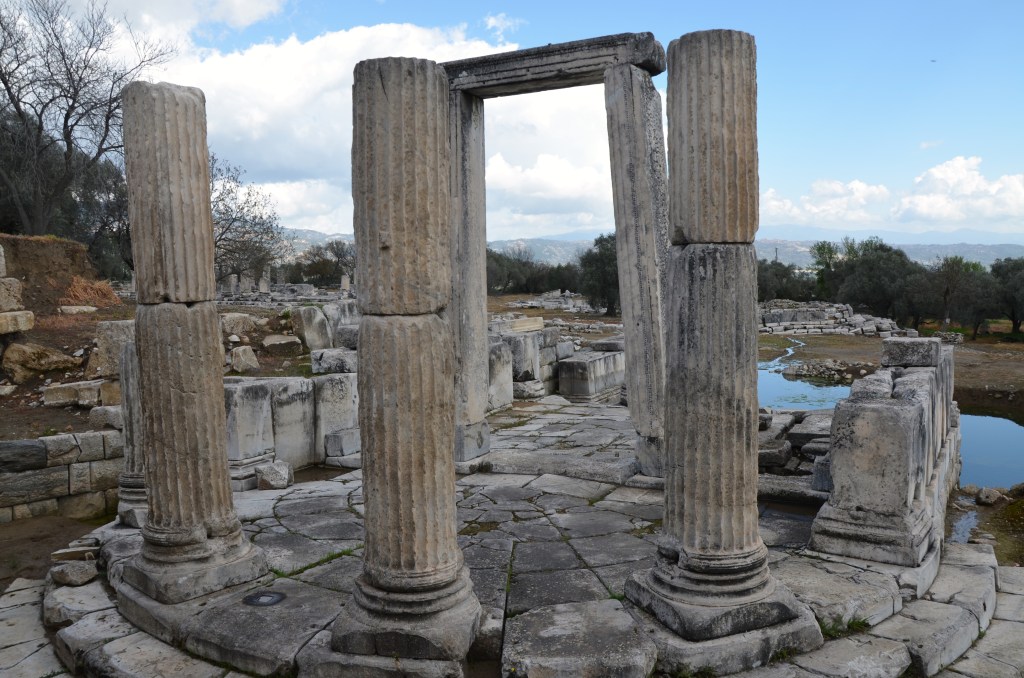
The Propylaea to Hekate’s temple at Lagina, photo from Wikimedia Commons

Stratonikeia was a very important city in what is now modern day Tรผrkiye, located in the western Anatolian region of Caria. Nearby, at Lagina, are remains of a great temple that was built to honor Hekate. This temple is currently the only known temple dedicated solely to Hekate that remains partially standing. It is also the only temple that functioned as a state-sponsored center of worship of Hekate.

One major aspect of rites honoring Hekate at Lagina was the “Kleidos Agoge” – the “Procession of the Key” (some references may call it the “Festival of the Key”). This festival took place every year and spanned a few days; games were played, music and hymns were offered to Hekate, and the Kleidos Agoge was the highlight of this multi-day annual celebration. A Kleidophoros, usually the young daughter of the temple priest, carried the temple key in a procession on the sacred road from the temple in Lagina to Stratonikeia. The key was brought to an altar dedicated to Hekate within an official council building in Stratonikeia, and visitors would then bring offerings and make sacrifices at this altar while the key was on display. The key was then returned to Lagina in another procession on the sacred road, and celebrations would then continue.


ยฉ Melissa M. / The Torch and Key


Sources:

Betz, Hans Dieter, editor.ย The Greek Magical Papyri in Translation, Including the Demotic Spells. Vol. 1, 2nd ed., University of Chicago Press, 1997.ย 

HERRING, AMANDA. โ€œReconstructing the Sacred Experience at the Sanctuary of Hekate at Lagina.โ€ Journal of the Society of Architectural Historians, vol. 79, no. 3, 2020, pp. 247โ€“63. JSTOR, https://www.jstor.org/stable/48740836. Accessed 16 May 2026.

The Covenant of Hekate, https://www.facebook.com/CovenantOfHekate/posts/epithetshekate-kleidouchos-the-bearer-of-the-keysthe-term-kleidouchos-means-the-/4581834658503710/

The Covenant of Hekate, https://www.hekatecovenant.com/post/the-cult-of-hecate
Hekate in Lagina: a goddess performing her civic duty

I really enjoy searching and reading academic papers about Hekate, and ancient Roman / Greek religious – cult practices in the ancient world. These papers aren’t usually widely circulated, and the hard work and time scholars put into researching and writing these papers often, sadly, go unnoticed.

I came across this paper I am linking here quite by happy accident, and I am so glad I found it. It is titled “Hekate in Lagina: a goddess performing her civic duty” written by Dr. Amanda Herring. The link leads to a landing page from Cambridge University, and this paper was included in their Anatolian Journal from August 2022. The PDF version of the paper must be downloaded in order to read it.

Link to paper (it will open a new browser tab): Hekate in Lagina: a goddess performing her civic duty

This paper delves into the cult of Hekate at Lagina / Stratonikeia in modern day Turkey. Here is a copied and pasted summary:

The Hellenistic Sanctuary of Hekate at Lagina represents the only site at which Hekate received state-sponsored cult at a monumental temple and a privileged place in the local pantheon. Elsewhere in Karia and the wider Greek world, Hekate was associated with magic and the underworld and received personal dedications at doorways and crossroads. This portrayal was echoed in art, where her character manifested in her triple-bodied form. Yet, at Lagina, part of the city of Stratonikeia, she was always represented with a single body. She was the focus of civic cult, in particular during the Hekatesia-Romaia festival, which celebrated the political alliance between Stratonikeia and Rome. Through an analysis of inscriptions, representations of the goddess in sculpture and coins, and the ritual use of the complex, this article concludes that Hekate of Lagina was a syncretic and singular figure who did not exist outside of Stratonikeia, and that her function at Lagina was primarily political, as a civic patron. As a goddess who oversaw lifeโ€™s transitions and acted as a saviour of her people, she was uniquely suited to the role. The goddess and her sanctuary were used by the local population to create community identities and to negotiate their relationships with the wider world, particularly their imperial rulers.

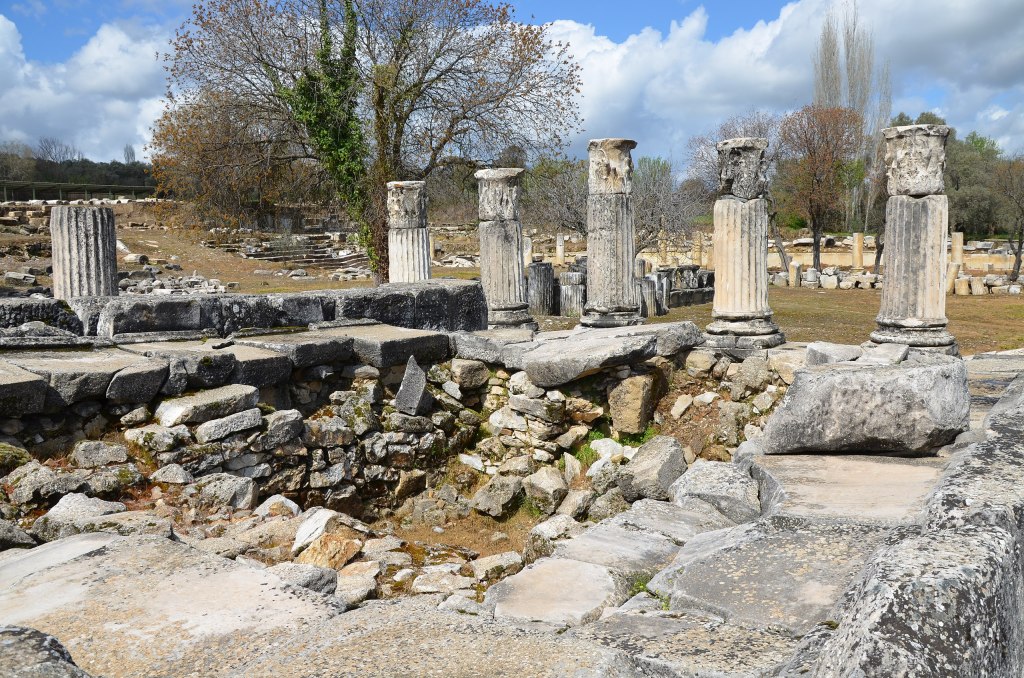
The Sanctuary of Hekate in Lagina, Caria, Turkey. Photo from Wikipedia

Hekate, Sekhmet, & Lions

Before COVID took over our corner of the Earth, my daughters and I visited the Albany Institute of History and Art near our home. On the third floor, they have an amazing exhibit dedicated to Ancient Egypt, with many artifacts and two preserved mummies of Egyptian Priests from the Ptolemaic Period (c. 305 BCE).

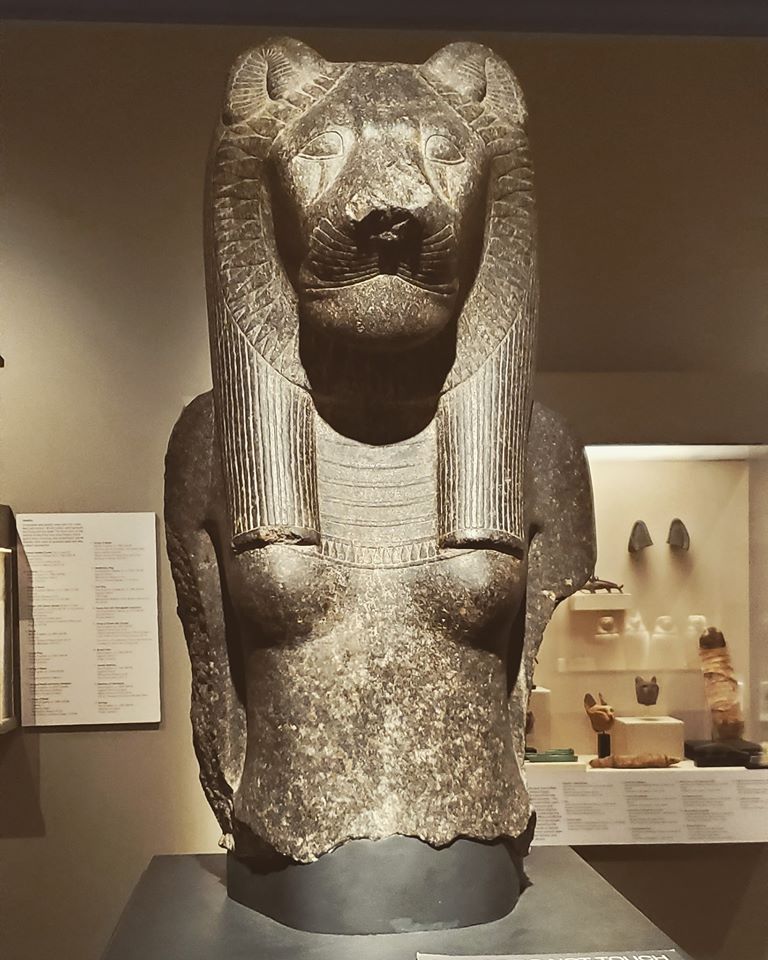
Almost everything on display was safely stored behind protective glass, except for the bust of the Goddess Sekhmet (see photo below). Seeing this bust of the great Lioness was breathtaking. It was displayed on a heavy stand, with a simple sign asking visitors not to touch it.

81602614_10220424119774269_5219959451758362624_o

Bust of the Goddess Sekhmet from the Temple of Mut at Karnak, dated between 1388-1350 BCE / Albany Institute of History and Artย  ยฉ 2020 Melissa McNair / The Torch and Key

This particular bust of Sekhmet was commissioned by Amenhotep III for the Temple of Mut at Karnak, and is believed to be dated from about 1388-1350 BCE. The temple of Mut was located in the present city of Luxor, Egypt on the banks of the Nile River.ย  The Goddess Mut was the consort of the God Amun-Ra, and was known as a Mother Goddess, a Sky Goddess, and was the mother of Khonsu, a Moon God.

Amenhotep III commissioned more than 500 statues of Sekhmet for the Temple of Mut, and it is believed that his intention was to have a “forest” of Sekhmet statues.

Sekhmet is a complex Goddess who embodies many different qualities. She is a terribly fierce defender of Ma’at (justice or balance), who is known to show her wrath when Ma’at is threatened. Sekhmet also has a nurturing side due to her role as healer and patroness of physicians –ย  but that gift of healing can also be used to harm by sending disease to those who offend her. She holds life and death in her hands.

Sekhmet and the Goddess Hekate do share similar qualities such as being mistresses of life and death, and as protectresses of justice and balance.

Hekate & Lions

Hekate is linked to lions through the Chaldean Oracles, temple remains found at Lagina, temple remains found near Syracuse (Sicily), various ancient coins showing Hekate with lions, and spells from the Greek Magical Papyri (PGM).

Chaldean Oracles

In the Chaldean Oracles, Hekate is seen as the Cosmic World Soul. She is the Anima Mundi; the mediator / messenger between the intellectual and material realms and within Her Cosmic Womb is where creation begins, with the paternal intellect planting the ideas within that womb. The Epiphany of Hekate in the Chaldean Oracles mentions lions in some translations:

“If you say this to me many times, you will observe all things to be a lion”

Meaning, if you called upon Hekate correctly, She will appear in lion form as a result.

Lagina

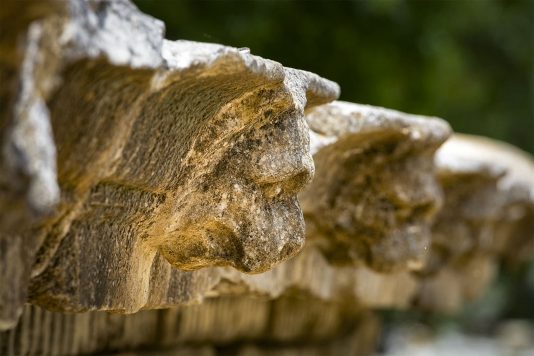
The Temple of Hekate in Lagina, Turkey is an ancient temple that was built around the 2nd century BCE. It was a sacred site dedicated to Hekate and was an important center of worship. There are preserved temple remains still there today, and one of them is a frieze containing lion heads (see below photo).

stunning-lion-heads-at-lagina-ancient-site-534x356

Lion heads at the Temple of Hekate at Lagina / photo ยฉ Slow Travel Guide


Sicily

In the ancient Greek colony of Akrai in modern day Sicily, there once stood a great temple to the Magna Mater (“Great Mother”). This temple is believed to have been built to worship the goddess Cybele. Many of the carvings / statues depict Cybele with lions.ย  Hekate and Cybele are closely related and some statues and carvings from the temple in Akrai depict Hekate either alone or alongside Cybele.

Ancient Coins

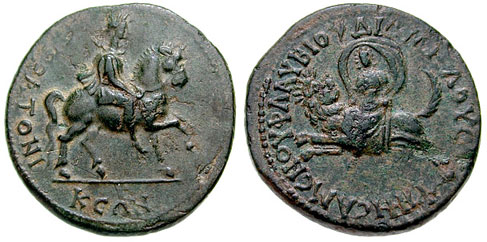
There are many ancient coins that depict Hekate either alone or with another deity. One particular coin from the region of Stratonikeia, near Lagina, shows Zeus on one side on horseback, with Hekate on the other side sitting atop a lion (see photo below).

coin

Coin depicting Zeus (left) and Hekate (right), CARIA, Stratonikeia. 1st-2nd Century AD. Image ยฉ WildWinds

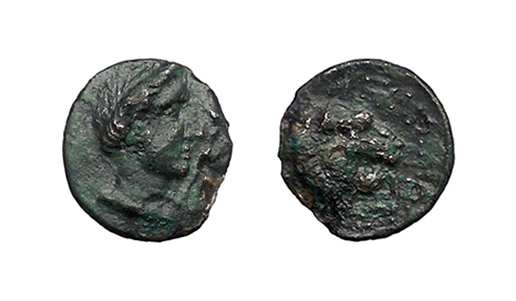
Another coin from Thessaly, dated to about 400 BCE, depicts Hekate’s head with a torch on one side and a lion on the other side (see below photo).

thessaly

Hekate / Lion coin from Thessaly, 400 BCE Image ยฉ WorthPoint


Sources:

  1. “Hekate Soteira” by Sarah Iles Johnston
  2. https://www.worthpoint.com/worthopedia/pherai-thessaly-404bc-hekate-1826761086
  3. https://www.wildwinds.com/coins/greece/caria/stratonikeia/i.html
  4. https://en.wikipedia.org/wiki/Precinct_of_Mut