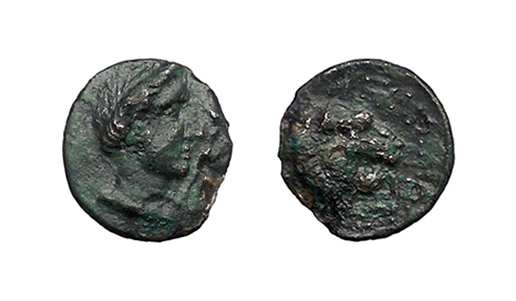
Hekate in Magna Graecia: Morgantina

Morgantina

Morgantina was a province in Enna, Sicily, which is roughly in the east-center of the island. Morgantina was settled sometime around 1000 BCE and life continued there until around 50 CE. In present day, the area is known as “Aidone”. Morgantina was the site of a major sanctuary to Demeter and Persephone, and many statues, votives, pottery, and curse tablets have so far been recovered at the site. Sadly, much looting was done here and artifacts are still being recovered and returned to Italy in present-day.
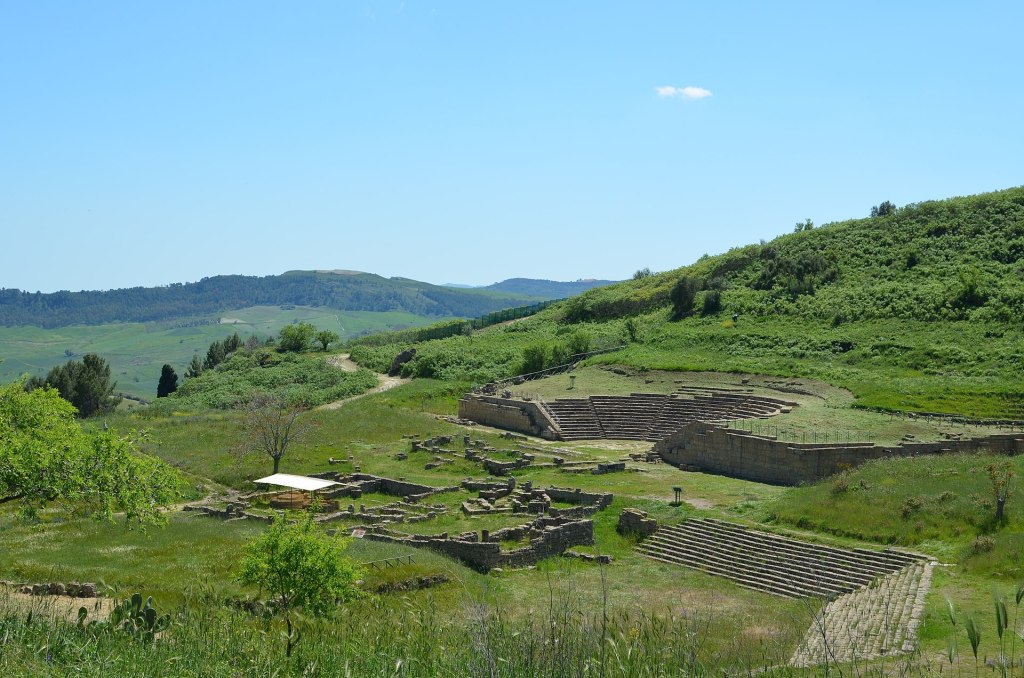
Remains of the sanctuary of Demeter & Persephone, and a Greek theater beyond the sanctuary. Image from Wikimedia Commons

Morgantina was home to a major sanctuary dedicated to Demeter and Persephone, the excavated remains of one may be seen in the above photo. Researchers discovered that there were actually five separate sanctuaries in Morgantina dedicated to Demeter and Persephone, and each one likely served different functions. They were located on each directional side (north, south, east, and west). Morgantina is near Pergusa, which is where Persephone was abducted by Hades. A main sanctuary, referred to as the “thesmophorion” to celebrate the Eleusinian mysteries, comprised of several different rooms, some of which were believed to be living quarters for the temple priestesses. Many different votive offerings were found surrounding the altars, and they mostly consisted of figurines and vases. Also found at the site were statues & busts of the goddesses, ritual clay lamps, and hair accessories. Some of the statues found show Persephone holding a piglet and torches. Other artifacts were found within the sanctuary, including items used for pressing oil and wine, and for grinding corn and other grains.

As seen in other sanctuaries to Demeter and Persephone, the main sanctuary at Morgantina has a propylon dedicated to a Chthonian goddess, possibly Hekate or Persephone. This propylon contains a pit in the ground for offerings (a “botros”), and a cylindrical stone altar. Animal bones (likely from pigs) and pottery votive offerings have been found within the botros.
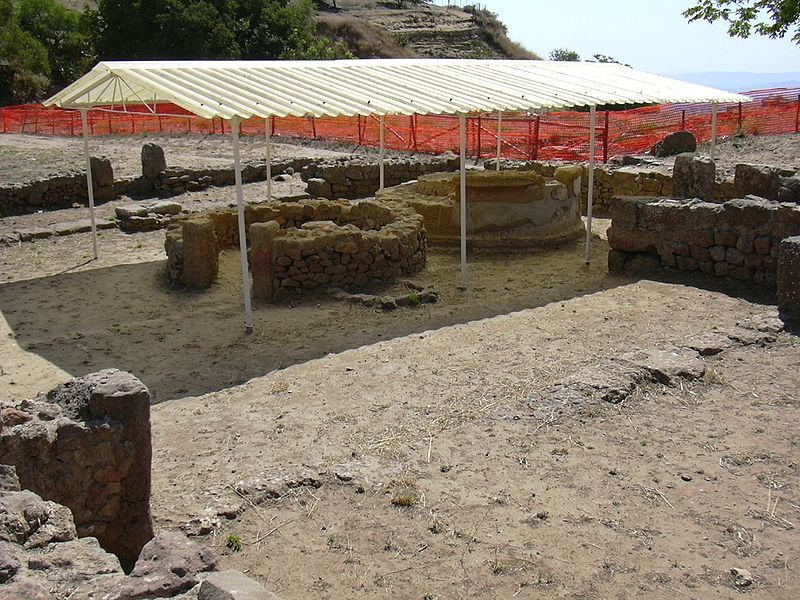
Propylon dedicated to a Chthonian goddess, showing a round altar and botros (offering pit). Public domain image from Wikipedia

Several lead curse tablets have also been found at Morgantina, and most have been unearthed from the offering pit in the sanctuary / propylon to the still-unnamed Chthonian goddess. One tablet, pictured below, is part of a group of four tablets all cursing a slave named Venusta, and asking the gods of the Underworld to take her to their realm of the dead.
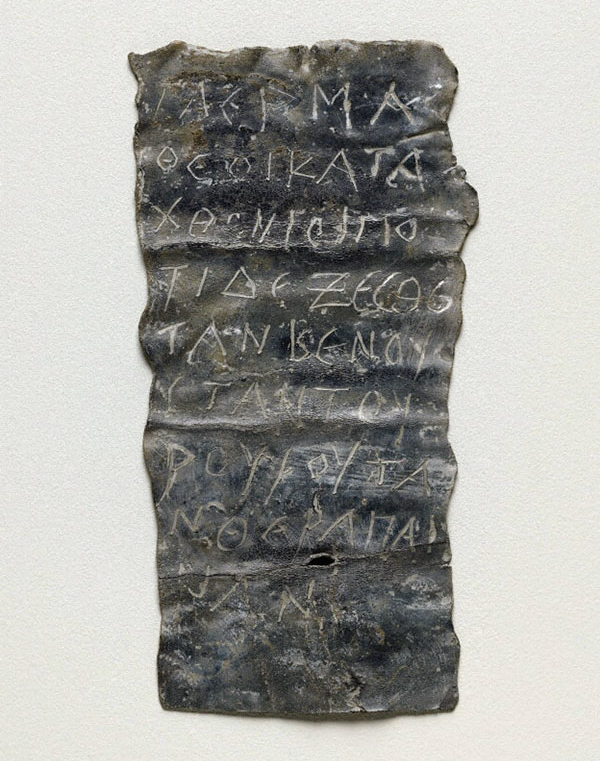
Curse Tablet, about 100 B.C., found in Morgantina, Sicily. Lead, 3 11/16 x 1 13/16 in. (9.4 x 4.6 cm). Museo Archeologico Regionale of Aidone. Photo from Getty Images.

I hope you enjoyed this short essay on Hekate in Magna Graecia: Morgantina. I will expand on this specific topic of Morgantina in the future.

ยฉ Melissa McNair / The Torch and Key


Sources:

Hekate Phosphoros

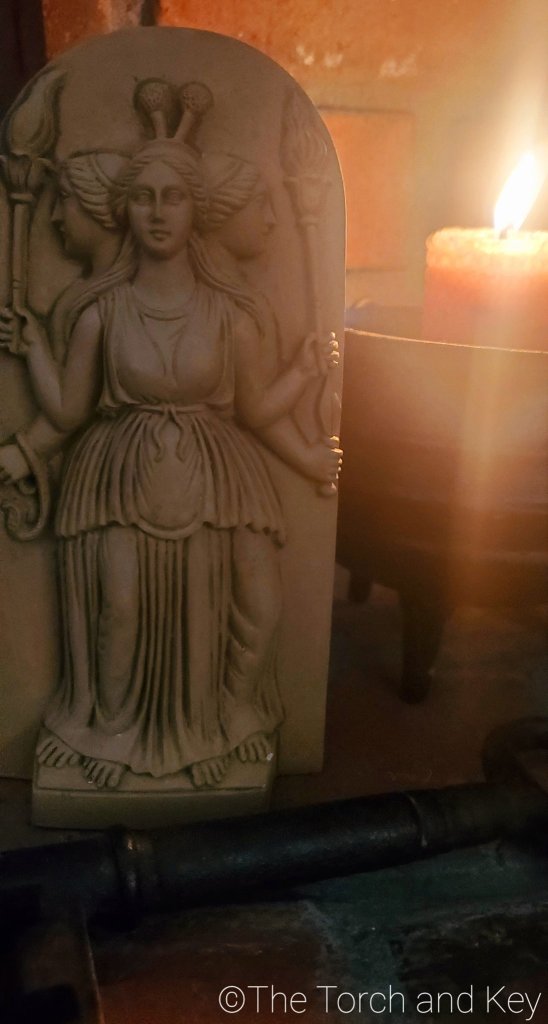
One of Hekate’s roles is that of Phosphoros – “Lightbringer” or “Lightbearer”. Hekate’s torches illuminate that which is dark. She leads the way, torch in hand, for those who have heeded Her call to immerse themselves in Her mysteries. Hekate’s torches also illuminate Truth by banishing ignorance and fear that breeds in the dark. That illumination can sometimes be a difficult and life changing process. There is a saying among many Hekateans: “En Erebos Phos” – “In darkness, there is light”. Darkness cannot exist without light, and light cannot exist without darkness. For me,  Hekate Phosphoros embodies that concept.

On this Equinox and another turn of the wheel, we in the Northern Hemisphere are celebrating Spring and the ever-growing light as we progress to brighter and longer days. In the Southern Hemisphere, Autumn has descended and the days are growing shorter and darker. Wherever you are in the world, we are all experiencing that balance of light and dark in this moment. Hekate as Anima Mundi stands at the crossroads of the universe – a place of balance.

Photo ยฉ Melissa McNair / The Torch and Key

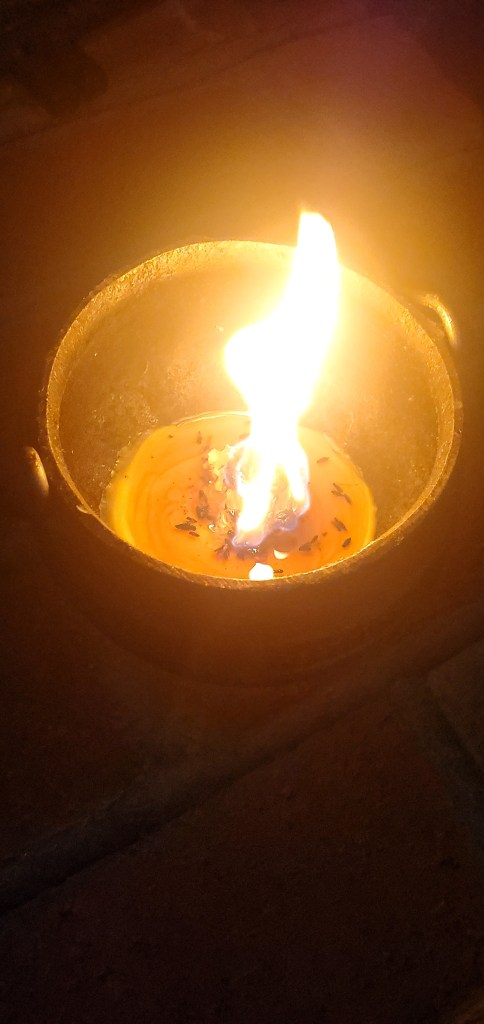
Today, I celebrated the return of Spring in a simple yet meaningful ritual. I made a beeswax candle using an ethically crafted beeswax sheet and rolled it up with dried organic lavender buds and a eco-friendly cotton wick. I decided to burn this candle completely in my mini cast iron cauldron, and I’m glad I did because once it neared the bottom, the sacred fire came alive, becoming enlarged and beautiful (see above photo). I sang praise to Hekate, honoring Her role as Phosphoros and Anima Mundi.

The Return of Spring and Persephone

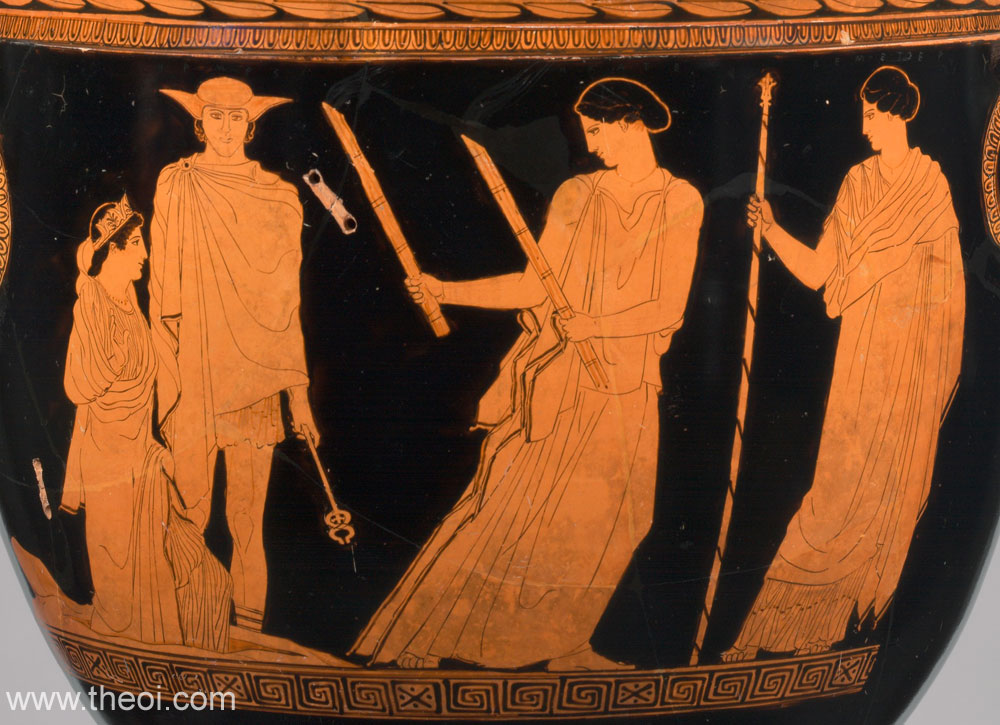
“The Return of Persephone”, Attic vase dated circa 440 BCE

Spring is traditionally a time of rebirth and renewal. The Earth is awakening from her winter slumber, and life is beginning to stir in both flora and fauna. The return of Spring also brings the return of Persephone from the Eleusinian Mysteries. The Rites of Eleusis were initiatory mysteries taking place in the autumn and spring, marking the descent of Persephone into the realm of the dead with her consort Hades (autumn), and Persephone’s return to the mortal world above to be reunited with her mother Demeter (spring). (see related blog post regarding Enna in Sicily).

Hekate had an integral role in these mysteries, acting as Persephone’s companion and guide during both her descent and return. Much isn’t known about the Eleusinian Mysteries, but scholars agree that it centered on the concept of life, death, and rebirth. The Eleusinian Mysteries were tied to the agricultural season of the Mediterranean region, and the mysteries were used to help explain the seasonal changes of growth and life, death and decay, and regeneration of that which died.

Hekate is a liminal goddess that straddles the realms of these forces with ease. Demeter represents life, Persephone represents death and rebirth, and Hekate as Creatrix weaves these energies together. All three goddesses were honored during these rites.

The image above is from a vase dated back to 440 BCE. It shows Persephone, on the left, returning from the realm of Hades. Hermes is standing next to Persephone, and Demeter is on the far right holding a scepter. Hekate is in the center, bearing two torches while guiding Persephone’s return.

๐Ÿ—


ยฉ Melissa McNair / The Torch and Key


Image source: Theoi, https://www.theoi.com/Gallery/T16.6.html

Hekate Soteira

The epithet “Soteira” is an important title of Hekate. Soteira means “Savior” and for me personally it is used in conjunction with Hekate’s role as “Cosmic World Soul”. An excellent book to read from scholar Sarah Iles Johnston titled “Hekate Soteira” delves into Hekate’s role as Savior and Cosmic World Soul within the Platonic / Chaldean philosophy.

What does “Cosmic World Soul” mean?

In the Chaldean Oracles, Hekate is irrevocably defined as the Cosmic World Soul – the Great Mother, the Anima Mundi, Creatrix of All. The source of primordial fire.

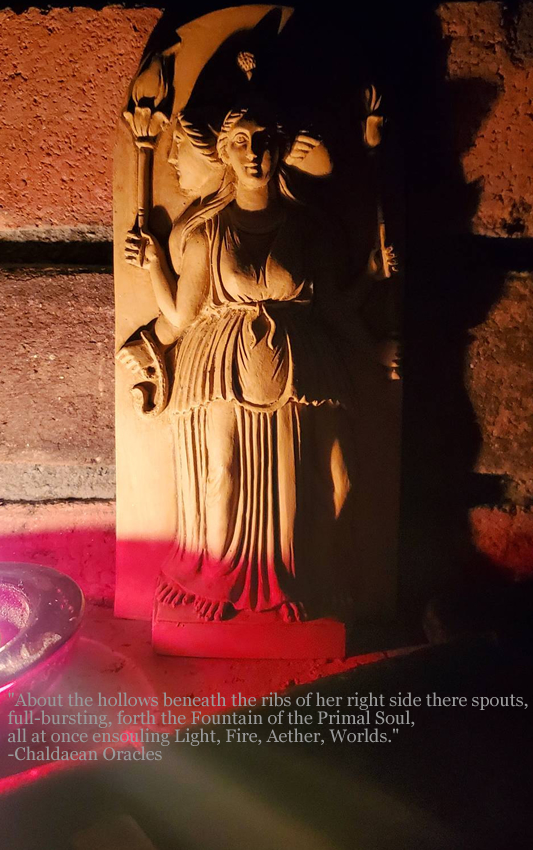
I have experienced many different sides to Hekate over the years, but the one that I “feel” the most is Hekate as this Great Mother; as one who facilitates life, death, rebirth, and everything in between. This excerpt from the Chaldean Oracles sums it up well, and the accompanying text (version from G.R.S. Mead), describes Hekate as “Great Mother/Magna Mater”, “Life of the Universe”, “Mother of Souls”, “Inbreather of Life”.

45

“About the hollows beneath the ribs of her right side there spouts, full-bursting, forth the Fountain of the Primal Soul, all at once ensouling Light, Fire, Aether, Worlds.”

47

“After the Father’s Thinkings, you must know, I, the Soul, dwell, making all things to live by Heat.”

In the Chaldean Oracles, the “Father” is described as existing as intellect or pure thought, while Hekate, as the Anima Mundi, puts forth his thoughts through creation.

During my personal devotionals, I often feel Hekate’s presence as this warm, glowing light. It’s hard to describe – but I when I feel Her presence in this way, I feel an abundance of Love. It is so pure; it’s hard to put into words. There were a few times where I actually witnessed a warm, golden glow appear around me. It is a very emotional and powerful experience; and very real. It doesn’t always happen. But when it does, I will most definitely bask in this sacred glow and honor Her radiance.

Photo ยฉ Melissa McNair / The Torch and Key

Hekate & the Perseids

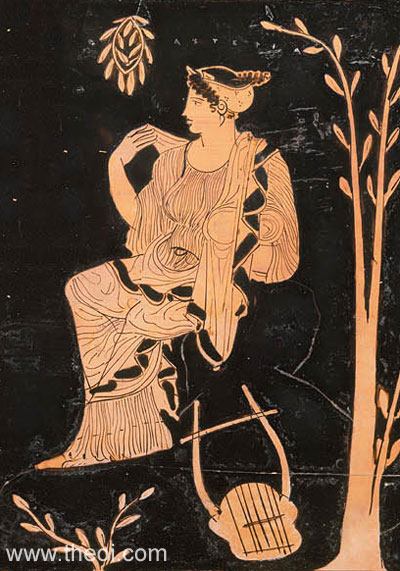
T15.1Asteria

Asteria, Athenian red-figure amphora C5th B.C.,ย Museum of Fine Arts Boston

“Also she [Phoebe] bore Asteria of happy name, whom Perses once led to his great house to be called his dear wife. And she conceived and bore Hecate whom Zeus the son of Cronos honored above all. He gave her splendid gifts, to have a share of the earth and the unfruitful sea. She received honor also in starry heaven, and is honored exceedingly by the deathless gods.”

-“Theogony”, Hesiod

Hesiod’s Theogony is the oldest written account of the Greek Gods, and Hekate is described as being honored by Zeus above all others in this story. The Theogony also names Asteria and Perses as Hekate’s parents. Asteria was a Titaness; she ruled theย  starry skies and her name means “starry one” or “falling star”. Perses was a Titan as well, and was the God of Destruction; his name means “Destroyer”.

The Perseids

The Perseid meteor showers are an annual stellar event that begins around the third week of July and typically peaks the second week of August, around the 10th or 11th and lasts a few days. The peak dates for 2020 are August 11th-13th. The meteors originate from the Perseus (a derivative of Perses) constellation. Because Perses is Hekate’s father and Hekate’s mother Asteria is associated with falling stars, the days that the Perseids are peaking are a wonderful time to honor Hekate (and Her parents).

Star Gazing

I love the night sky. Each evening before bed, I go outside and just soak in the beauty of the dark night. I gaze at the sky, and take note of every star twinkling like night’s own torches. I raise my hands to the sky, recite a portion of an Orphic oath from the Petelia tablet:

“I am a child of Earth and Starry Heaven, but my race is of Heaven alone”

From there, I utter words honoring Hekate, her role as guardian of the Heavens (as apportioned to her by Zeus in the Theogony), and recite epithets, chants – whatever I am moved to speak at that moment. There is no script, there are no written rules. Most often I will see a shooting star while I am speaking, or after I am done. I always humbly accept that as a sign that my words and offerings were received favorably and with gratitude. In turn, I express my own gratitude for Hekate’s recognition and presence.

That is my nightly ritual before I go to bed. Doing this each night feeds my soul like nothing else. It is a very fulfilling part of my devotional practice. When the Perseids are at peak, I spend more time outside, chanting and gazing in wonder at the night sky while this magical stellar event takes place.


ยฉ Melissa McNair / The Torch and Key


Sources:

  1. https://www.theoi.com/Khthonios/Hekate.html
  2. https://www.theoi.com/Titan/TitanisAsteria.html

Hekate, Sekhmet, & Lions

Before COVID took over our corner of the Earth, my daughters and I visited the Albany Institute of History and Art near our home. On the third floor, they have an amazing exhibit dedicated to Ancient Egypt, with many artifacts and two preserved mummies of Egyptian Priests from the Ptolemaic Period (c. 305 BCE).

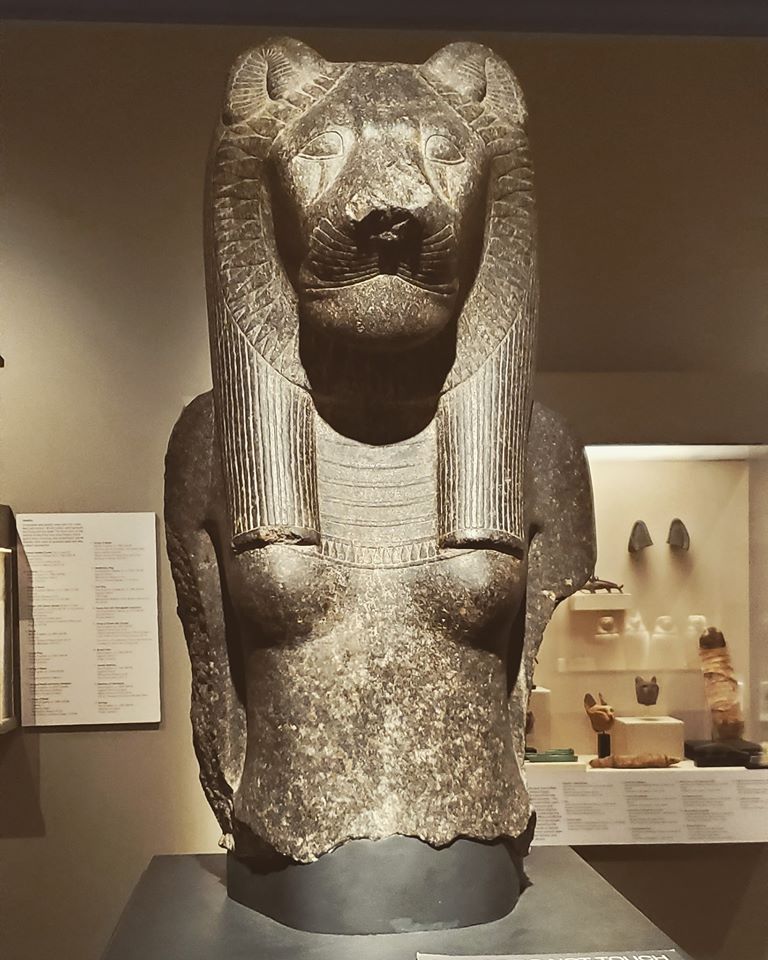
Almost everything on display was safely stored behind protective glass, except for the bust of the Goddess Sekhmet (see photo below). Seeing this bust of the great Lioness was breathtaking. It was displayed on a heavy stand, with a simple sign asking visitors not to touch it.

81602614_10220424119774269_5219959451758362624_o

Bust of the Goddess Sekhmet from the Temple of Mut at Karnak, dated between 1388-1350 BCE / Albany Institute of History and Artย  ยฉ 2020 Melissa McNair / The Torch and Key

This particular bust of Sekhmet was commissioned by Amenhotep III for the Temple of Mut at Karnak, and is believed to be dated from about 1388-1350 BCE. The temple of Mut was located in the present city of Luxor, Egypt on the banks of the Nile River.ย  The Goddess Mut was the consort of the God Amun-Ra, and was known as a Mother Goddess, a Sky Goddess, and was the mother of Khonsu, a Moon God.

Amenhotep III commissioned more than 500 statues of Sekhmet for the Temple of Mut, and it is believed that his intention was to have a “forest” of Sekhmet statues.

Sekhmet is a complex Goddess who embodies many different qualities. She is a terribly fierce defender of Ma’at (justice or balance), who is known to show her wrath when Ma’at is threatened. Sekhmet also has a nurturing side due to her role as healer and patroness of physicians –ย  but that gift of healing can also be used to harm by sending disease to those who offend her. She holds life and death in her hands.

Sekhmet and the Goddess Hekate do share similar qualities such as being mistresses of life and death, and as protectresses of justice and balance.

Hekate & Lions

Hekate is linked to lions through the Chaldean Oracles, temple remains found at Lagina, temple remains found near Syracuse (Sicily), various ancient coins showing Hekate with lions, and spells from the Greek Magical Papyri (PGM).

Chaldean Oracles

In the Chaldean Oracles, Hekate is seen as the Cosmic World Soul. She is the Anima Mundi; the mediator / messenger between the intellectual and material realms and within Her Cosmic Womb is where creation begins, with the paternal intellect planting the ideas within that womb. The Epiphany of Hekate in the Chaldean Oracles mentions lions in some translations:

“If you say this to me many times, you will observe all things to be a lion”

Meaning, if you called upon Hekate correctly, She will appear in lion form as a result.

Lagina

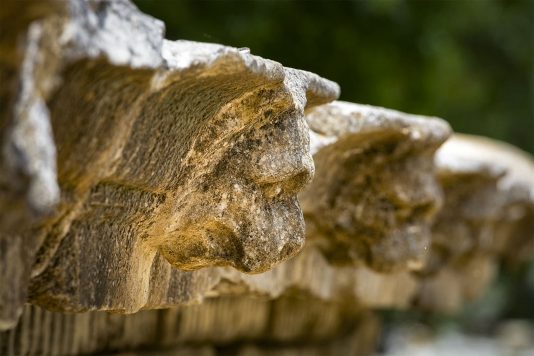
The Temple of Hekate in Lagina, Turkey is an ancient temple that was built around the 2nd century BCE. It was a sacred site dedicated to Hekate and was an important center of worship. There are preserved temple remains still there today, and one of them is a frieze containing lion heads (see below photo).

stunning-lion-heads-at-lagina-ancient-site-534x356

Lion heads at the Temple of Hekate at Lagina / photo ยฉ Slow Travel Guide


Sicily

In the ancient Greek colony of Akrai in modern day Sicily, there once stood a great temple to the Magna Mater (“Great Mother”). This temple is believed to have been built to worship the goddess Cybele. Many of the carvings / statues depict Cybele with lions.ย  Hekate and Cybele are closely related and some statues and carvings from the temple in Akrai depict Hekate either alone or alongside Cybele.

Ancient Coins

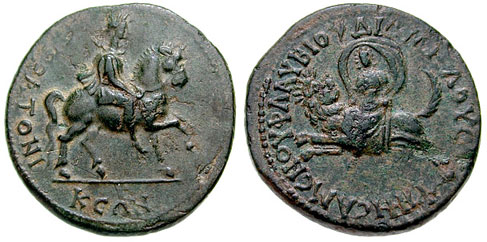
There are many ancient coins that depict Hekate either alone or with another deity. One particular coin from the region of Stratonikeia, near Lagina, shows Zeus on one side on horseback, with Hekate on the other side sitting atop a lion (see photo below).

coin

Coin depicting Zeus (left) and Hekate (right), CARIA, Stratonikeia. 1st-2nd Century AD. Image ยฉ WildWinds

Another coin from Thessaly, dated to about 400 BCE, depicts Hekate’s head with a torch on one side and a lion on the other side (see below photo).

thessaly

Hekate / Lion coin from Thessaly, 400 BCE Image ยฉ WorthPoint


Sources:

  1. “Hekate Soteira” by Sarah Iles Johnston
  2. https://www.worthpoint.com/worthopedia/pherai-thessaly-404bc-hekate-1826761086
  3. https://www.wildwinds.com/coins/greece/caria/stratonikeia/i.html
  4. https://en.wikipedia.org/wiki/Precinct_of_Mut