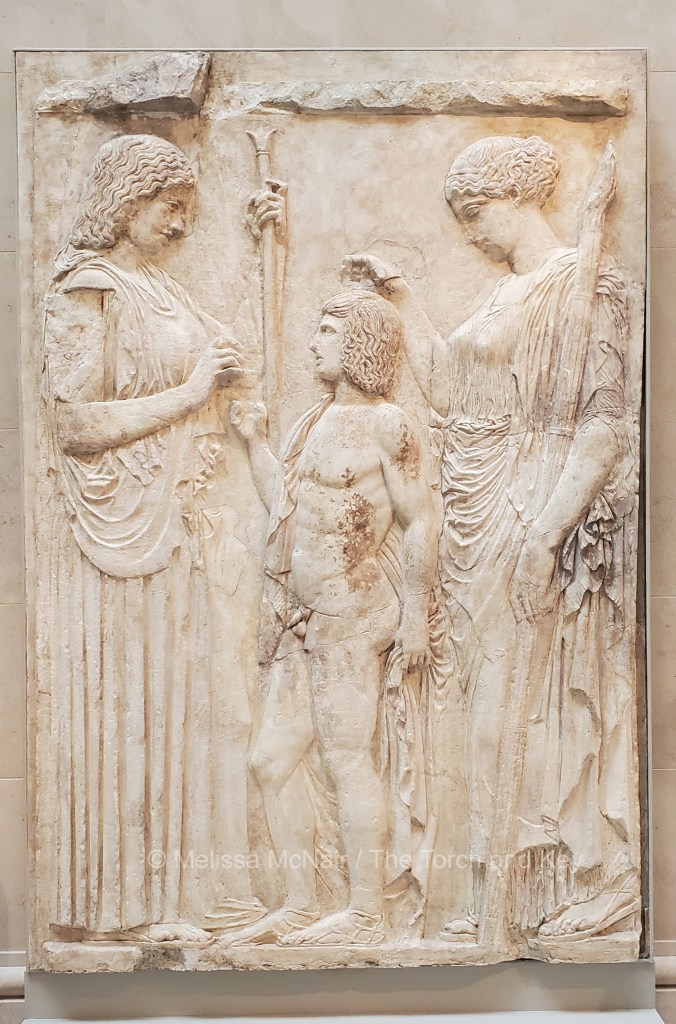
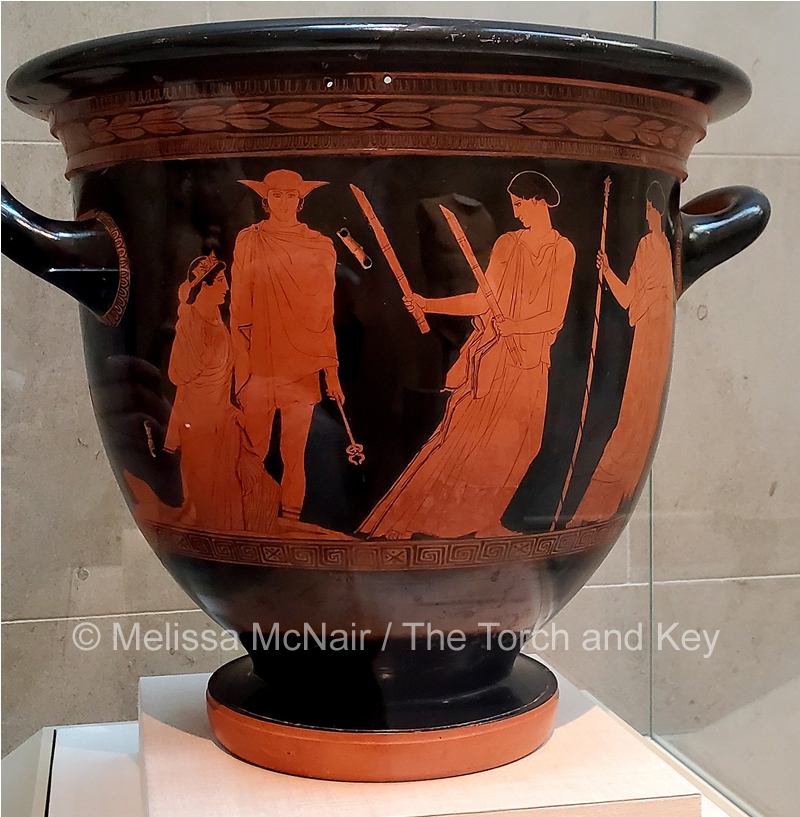
Morgantina was a province in Enna, Sicily, which is roughly in the east-center of the island. Morgantina was settled sometime around 1000 BCE and life continued there until around 50 CE. In present day, the area is known as “Aidone”. Morgantina was the site of a major sanctuary to Demeter and Persephone, and many statues, votives, pottery, and curse tablets have so far been recovered at the site. Sadly, much looting was done here and artifacts are still being recovered and returned to Italy in present-day.
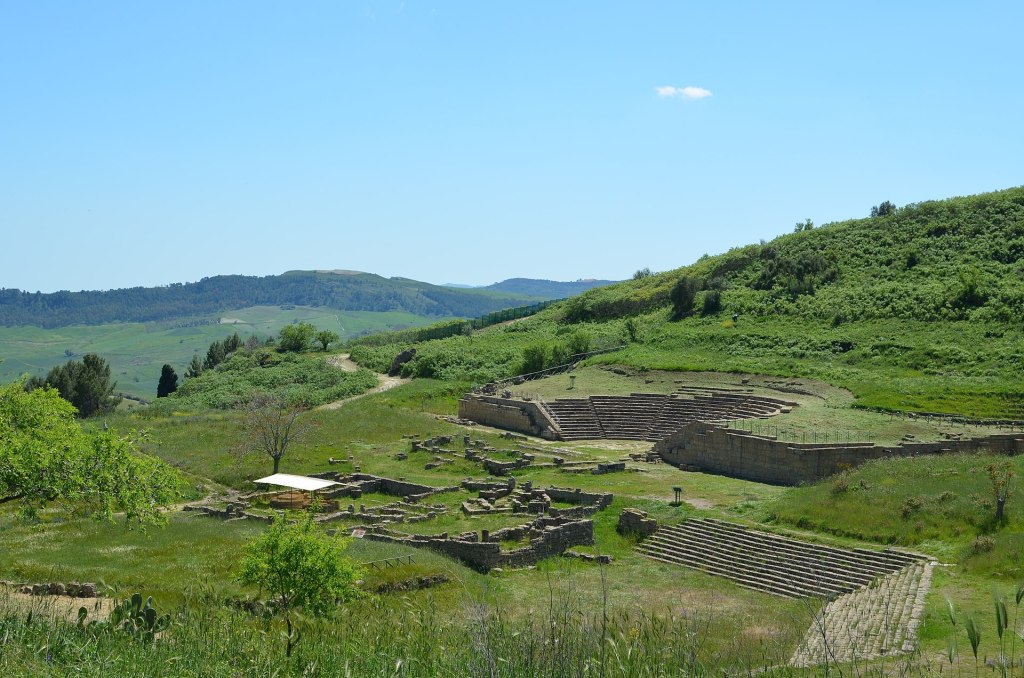
Remains of the sanctuary of Demeter & Persephone, and a Greek theater beyond the sanctuary. Image from Wikimedia Commons
Morgantina was home to a major sanctuary dedicated to Demeter and Persephone, the excavated remains of one may be seen in the above photo. Researchers discovered that there were actually five separate sanctuaries in Morgantina dedicated to Demeter and Persephone, and each one likely served different functions. They were located on each directional side (north, south, east, and west). Morgantina is near Pergusa, which is where Persephone was abducted by Hades. A main sanctuary, referred to as the “thesmophorion” to celebrate the Eleusinian mysteries, comprised of several different rooms, some of which were believed to be living quarters for the temple priestesses. Many different votive offerings were found surrounding the altars, and they mostly consisted of figurines and vases. Also found at the site were statues & busts of the goddesses, ritual clay lamps, and hair accessories. Some of the statues found show Persephone holding a piglet and torches. Other artifacts were found within the sanctuary, including items used for pressing oil and wine, and for grinding corn and other grains.
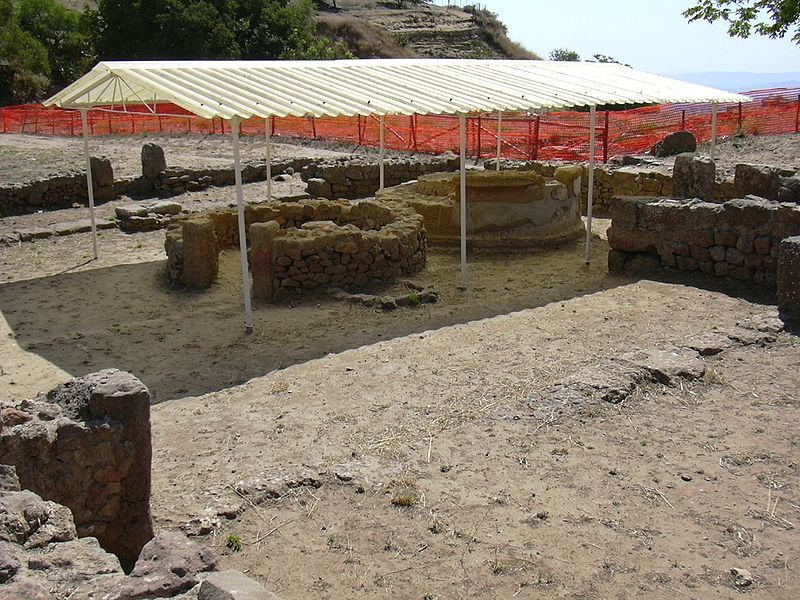
As seen in other sanctuaries to Demeter and Persephone, the main sanctuary at Morgantina has a propylon dedicated to a Chthonian goddess, possibly Hekate or Persephone. This propylon contains a pit in the ground for offerings (a “botros”), and a cylindrical stone altar. Animal bones (likely from pigs) and pottery votive offerings have been found within the botros.
Propylon dedicated to a Chthonian goddess, showing a round altar and botros (offering pit). Public domain image from Wikipedia
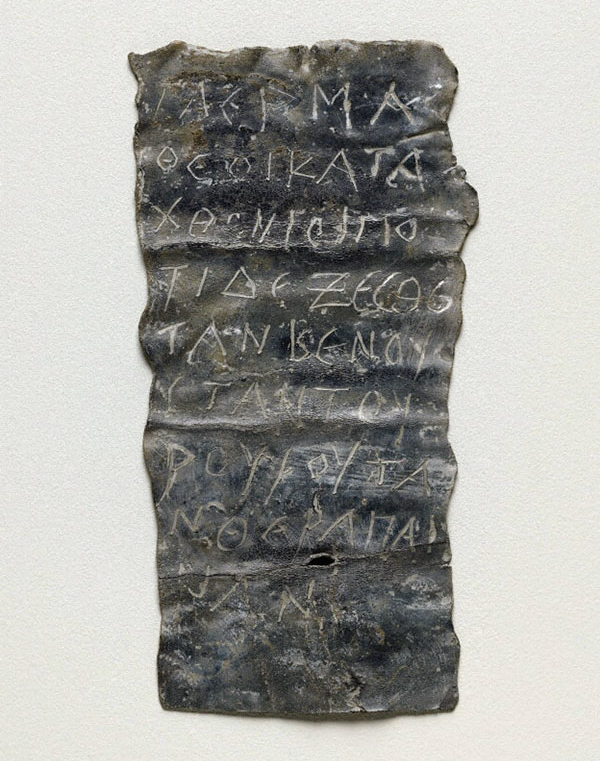
Several lead curse tablets have also been found at Morgantina, and most have been unearthed from the offering pit in the sanctuary / propylon to the still-unnamed Chthonian goddess. One tablet, pictured below, is part of a group of four tablets all cursing a slave named Venusta, and asking the gods of the Underworld to take her to their realm of the dead.
Curse Tablet, about 100 B.C., found in Morgantina, Sicily. Lead, 3 11/16 x 1 13/16 in. (9.4 x 4.6 cm). Museo Archeologico Regionale of Aidone. Photo from Getty Images.
I hope you enjoyed this short essay on Hekate in Magna Graecia: Morgantina. I will expand on this specific topic of Morgantina in the future.
Exploring the Misteri di Trapani and Demeter’s Search for Persephone
Trapani (sometimes referred to as “Drepana”) is a city on the northwest tip of Sicily, and was founded by the Elymians approximately 3rd century BCE. There are a few legends as to the founding of Trapani (near Eryx / Erice), and one of them involves Demeter’s search for Persephone after her abduction by Hades. According to the legend, Demeter dropped her sickle while searching for Persephone, which would explain why the coastal land resembles the curved blade of a sickle.
Sicily was once known as Magna Graecia, and the echoes of that past are evident just about everywhere you go on that magical island. Even though Catholicism became the dominant religion in Italy, the “old ways” were kept by rural peasants especially in Sicily, and were disguised as Catholic to keep up appearances. One such practice is the veneration of the Black Madonna. The Catholic Church has a simplistic explanation for Black Madonnas – mostly that the statues / icons of the Virgin Mary “aged” over the years, darkening the coloring of the icon. But those who know, know that the Black Madonna is the divine feminine – a concept carried over from the old ways. We know Her by many names: Dark Mother, Demeter, Melaina, etc. The Catholic Virgin and Child is said by many to actually represent Demeter and Persephone, especially in Sicily where the Eleusinian Mysteries were carried out long ago in places like Selinunte and Locri. The story of Demeter and Persephone – from Persephone’s abduction to Demeter’s search for her – has been kept alive in Sicily in various ways, and one can find echoes of that in the annual Easter procession in Trapani.
Misteri
The Procession of the Mysteries in Trapani started over 400 years ago and people come from far and wide to witness this event every year. Near the end of Holy Week, on Good Friday (as of this writing in 2022 that day falls on April 15th), the procession begins with many floats depicting the passion and death of Christ. Each statue represents each station of the cross along the Via Dolorosa (“sorrowful road”), and the statues are usually crafted by local artisan guilds. In Trapani, there are two processions for the Holy Mother: an official church procession for the “white” Madonna Addolorata (“sorrowful mother”); and a second procession of the Black Madonna – the divine feminine.
Many women of Sicily, to the dismay of the Catholic church, have always venerated the Black Madonna, sometimes in secret. To these women, the Black Madonna represents the divine feminine presence in all women and creation; the powerful Earth Mother whose blackness represents the dark, fecund earth and fertility. Simply, the Black Madonna is the protectress of the poor and marginalized people of society, and is called upon for social justice and righting wrongs. She is also the Dark Mother; the powerful force of life, death, and rebirth.
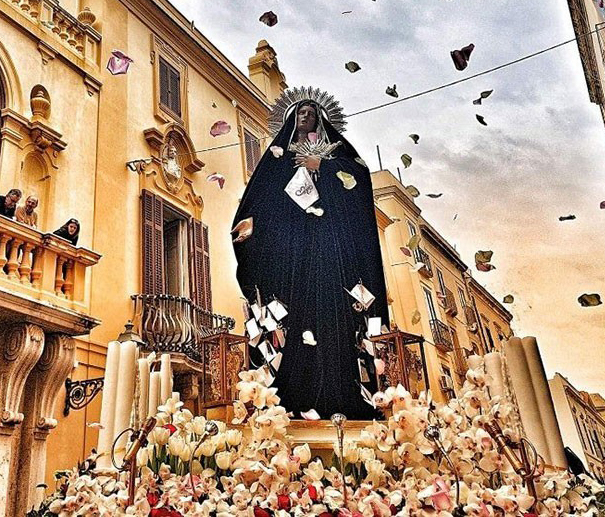
With the traditional Good Friday procession that includes the Madonna Addolorata, the statues of the son and mother separate at the beginning before the son begins the way of the cross that leads to his death. This is a solemn procession, with the mother cloaked in her dark mantle desperately searching for her beloved son. This scene transcends religions and cultures and is such a powerful display that evokes ancient, ancestral memories. During these mysteries, the statue of the Madonna is joined by a statue of John the evangelist (a saint, believed by some to be one of the Apostles), and they are carried all over town in search of the son. The Holy Week mysteries come to a conclusion on Easter Sunday, when the son is resurrected/reborn and reunited with his mother.
Madonna Addolorata, photo by Processione dei Misteri di Trapani
Eleusinia
Trapani is not that far from Enna, where according to Sicilian lore Persephone was abducted by Hades on the shores of Lake Pergusa while she was picking flowers with her maidens. The story of Persephone’s abduction and Demeter’s search for her is told in the Homeric Hymn to Demeter. Hekate assisted Demeter in her search for Persephone, with her torches illuminating the way. During this time, Demeter caused all crops to wither and trees and flowers went dormant while Persephone was in the underworld with Hades. Eventually, Demeter and Persephone were reunited after Zeus intervened and tasked Hermes the Messenger to mediate between Demeter and Hades to make arrangements for Persephone’s return. Hades tricked Persephone into eating pomegranate seeds, forever binding her to the underworld. Hekate then became Persephone’s torch-bearing guide on her travels between the realms in the spring and autumn. The Eleusinian Mysteries celebrated the mysteries of life, death, and rebirth.
The Madonna’s search for her beloved son is similar to Demeter’s search for Persephone. Both mother figures are experiencing pain and a deep, aching dread. Their searches are wrought with sorrow, frustration, and grief. One may say, when witnessing the procession of the Madonna Addolorata cloaked in her dark mantle, that she held a quiet rage within her. Rage for being separated from her child, and rage for wanting justice.
Demeter’s grief over losing Persephone eventually turned to rage, when she caused all crops, plants, flowers, and trees to wither and die while she was searching for her daughter. She decreed the lands to be eternally barren while separated from her beloved Persephone. In the Homeric Hymn to Demeter, she is described as being veiled (“Kyanopeplos”), not unlike the Madonna, during her search for Persephone:
“Bitter pain seized her heart, and she rent the covering upon her divine hair with her dear hands: her dark cloak she cast down from both her shoulders and sped, like a wild-bird, over the firm land and yielding sea, seeking her child.”
“[Demeter mourning Persephone] walked behind . . . with her head veiled and wearing a dark cloak which waved about the slender feet of the goddess . . . “
Homeric Hymn 2 to Demeter
The ancient Greeks associated this myth with the changing of the seasons from summer to dormant autumn with her abduction, and Persephone’s return to the world of the living with the return of spring. To this day, many Sicilians living on country farms make offerings to Demeter for bountiful harvests and express their gratitude for their prosperity and abundance during the growing seasons.
I hope you enjoyed this short blog post about the magical Misteri, and that it has perhaps inspired you to delve into the mysteries of the Black Madonna and her connections to Demeter and Hekate. Sicily is forever in my heart, my soul, and in my bones. It is my ancestral land; the history, the lore, the ancient memories are etched within me. I have been a devotee of Hekate for many years, and Demeter and Persephone are close to my heart as well.