Agrigento/Akragas
Another major area that was settled by the Greeks in Sicily is Agrigento (also known as Akragas or Agrigentum), and the area is named “Valley of the Temples” due to the many temples that have remains in this area. The Valley of the Temples is a major tourist destination, attracting visitors from all over the world.
Agrigento was a very prosperous city, which rivaled that of Syracuse’s power and prosperity. Agrigento is located on the southern coast of Sicily, situated between two rivers. This area boasts many temples, including temples to Zeus, Hera, Heracles, Concordia (one of the best preserved temples in Magna Graecia), Castor and Pollux (the Dioscuri), Hephaestus, Isis, Asclepius, Athena, and of course – Demeter and Persephone, which was part of a temple to Chthonic deities.
The temple in Agrigento dedicated to chthonic deities, namely Demeter and Persephone, will also include Hekate, though Hekate’s associations may be a bit obscure. This trio of goddesses was frequently worshipped together due to their Eleusinian connections.
Today, the temple itself is actually partially buried under ground, with the church of San Biagio now standing above it. San Biagio – how he is known in Italy – is in other areas of Europe known by the name of Saint Blaise, and was known for being a “physician of souls”. Curiously, icons representing Saint Blaise depict him bearing two crossed candles. Other icons representing him show him in a cave surrounded by wild beasts. His feast day falls on February 3rd, the day after Candlemas (also known as Imbolc). Some areas of Europe also honor him on Candlemas itself. Hekate, as it is known, is most often depicted carrying a torch in each hand and is sometimes celebrated on Imbolc, due to Her epithet of “Phosphorus”, which means “light-bearer” or “light-bringer”.
The remains of Demeter’s temple dates back to approximately 470 BCE. The base of the original structure of the temple is still preserved and partly visible, and it measures approximately 30 by 13 meters. Other remaining, visible parts of this temple have been incorporated into the church, such as water spouts in the shape of lions’ heads that can still be seen today. Some of these may be found in the regional Agrigento museum. If you are familiar with the Chaldean Oracles, then this piece of architecture would be of great interest, as Hekate was said to at times appear in “lion form” in the Oracles. Other interesting archaeological finds from this temple include ritual vessels (kernoi) linked to Persephone (likely used for offerings), remains of oil lamps used for ritual processions, and remains of stone busts possibly depicting Demeter, though that has not been confirmed to indeed be Demeter.
Next to the Temple of Demeter, you will find a series of connected caves used for ritual purposes. The walls of this subterranean complex contain grooves for holding ritual offerings and votive statues. A connecting rock wall between the caves reveals an aqueduct, utilizing the natural underground waterway found there. This is an exciting find, because this ritual cave complex is believed to have been connected to Demeter’s temple and would likely have been considered a “gateway to the underworld”, similar to other temple sanctuaries found in Greece, most notably Eleusis itself. It is known that many cults belonging to Hekate in Greece used caves for rituals honoring Her, such as the Zerynthian caves in Samothrace.
Separately from Demeter, it is believed that Artemis was worshiped in Akragas as “Artemis Soteira”. “Soteira” is another epithet belonging to Hekate and means “savior”. Hekate is referenced as savior in the Chaldean Oracles and Sarah Iles Johnston has devoted an entire book on the subject, titled Hekate Soteira: A Study of Hekate’s Roles in the Chaldean Oracles and Related Literature. 3rd century coins depicting the head of Artemis as “Soteira” have been found.
Hekate and Artemis do share a couple of other epithets, including “Phosphoros” (“light-bearer” or “light-bringer”); “Propylaia” (“at the gate” or “before the gate”).
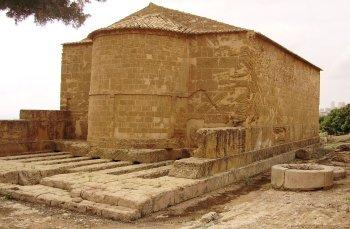
Agrigento – Church of San Biagio on foundation of the Temple of Demeter – Wikimedia
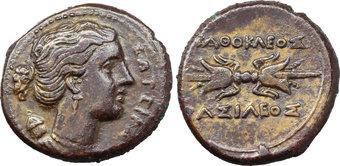
3rd century BCE coin depicting Artemis Soteira, found in Akragas
I hope you enjoyed this essay on Hekate in Magna Graecia: Akragas/Agrigento.
© Melissa McNair / The Torch and Key
Sources:
- “Agrigento: Valley of the Temples”, http://www.italia.it/en/travel-ideas/unesco-world-heritage-sites/agrigento-the-valley-of-the-temples.html
- “Saint Blaise”, https://en.wikipedia.org/wiki/Saint_Blaise
- Capraro, Corrado. “The Temple of Demeter”, http://www.valleyofthetemples.com/Temple_of_Demeter
- Mead, G.R.S. Chaldean Oracles Vol. 2. London: The Theosophical Publishing Society, 1908
- Capraro, Corrado. “The Temple of Demeter”, http://www.valleyofthetemples.com/Temple_of_Demeter
- “The Rupe Athenea: The Temple of Demeter and the Rocky Sanctuary”, http://www.inagrigento.com/the-rupe-athenea-the-temple-of-demeter-and-the-rocky-sanctuary/
- Fischer-Hansen, Tobias (editor). Poulson, Birte (editor). From Artemis to Diana: Goddess of Man and Beast (Acta Hyperborea). Denmark: Museum Tusculanum Press, 2009
- Mead, G.R.S. Chaldean Oracles Vol. 2. London: The Theosophical Publishing Society, 1908
- Johnston, Sarah Iles. Hekate Soteira. Atlanta: Scholars Press, 1990