- Please see the Hekate in Magna Graecia page for more information on this project
Scyllaeum
Scyllaeum is another colony in Magna Graecia, and was home to the mythical sea monster Scylla (or Skylla). Scyllaeum was located in the Calabria region of Southern Italy. The Hekatean connection here is parentage. In Appollonius Rhodius Argonautica, Hekate Krataiis (epithet meaning “rocky” or “mighty”) and the sea god Phorkys were parents to the sea monster Skylla:
“Ausonian Skylla (Scylla), the wicked monster borne to Phorkys (Phorcys) by night-wandering Hekate (Hecate), whom men call Kratais (Crataeis).”
Skylla was a sea monster that haunted the rocks in the waters off the coast, and any ships that sailed too close would lose their men to one of Skylla’s many monstrous heads. Skylla was situated between the coast and a whirlpool of Kharybdis, another sea monster that threatened ships in the waters off the coast. Another passage from the Argonautica details the warnings given against Skylla and Kharybdis:
“[Hera commands the sea-goddess Thetis to guide the Argonauts safely past Skylla (Scylla) :] ‘And do not let my friends [the Argonauts] be so unwary as to fall into Kharybdis (Charybdis), or at one gulp she will swallow them all. Nor let them go too near the hateful den of Ausonian Skylla (Scylla), the wicked monster borne to Phorkys by nigh-wandering Hekate (Hecate), whom men call Kratais (Crataeis)–or she may swoop down, take her pick and destroy them in her terrible jaws. What you must do is so to guide the ship that they escape disaster, if only by a hair’s breadth.’”
Strabo described Scyllaeum as a projecting rocky headland that juts out into the sea, joined to the mainland by an isthmus that forms a bay on each side. The village is active today and is known by the name of Scilla, and boasts a little over 5000 residents. It is primarily a fishing village, and it is also an active tourist destination.
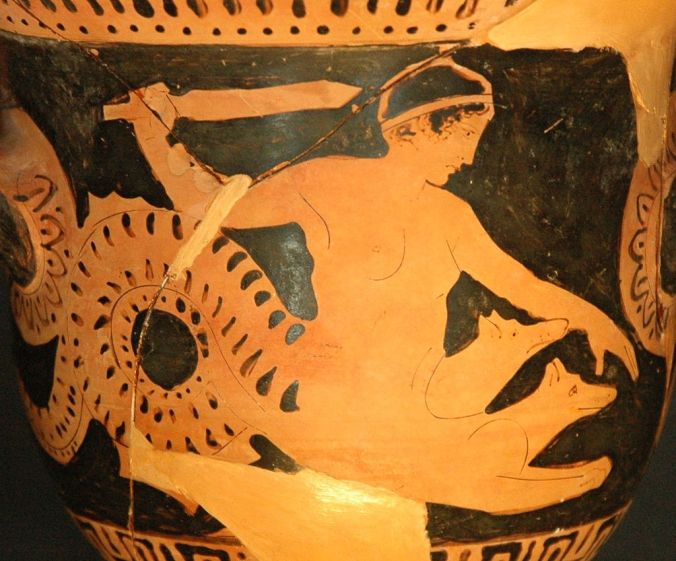
Scylla as a maiden with a kētos tail and dog heads sprouting from her body. Detail from a red-figure bell-crater in the Louvre, 450–425 BCE. This form of Scylla was prevalent in ancient depictions, though very different from the description in Homer, where she is land-based and more dragon-like. Image from Wikimedia.
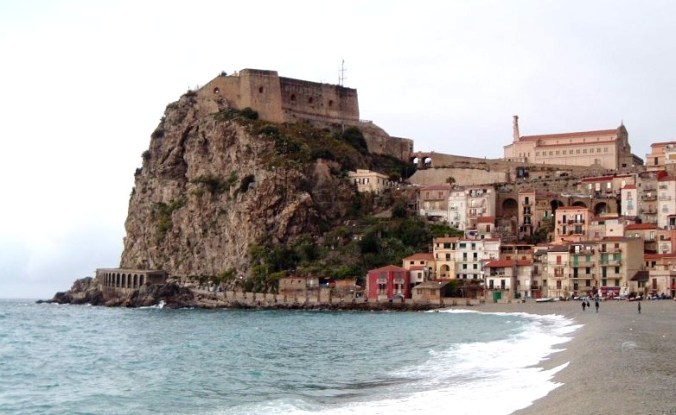
The Rock of Scilla, Calabria, which is said to be the home of Scylla. Image from Wikimedia.
I hope you enjoyed this essay on Hekate in Magna Graecia: Scyllaeum.
© Melissa McNair / The Torch and Key
Sources:
- “Skylla”, http://www.theoi.com/Pontios/Skylla.html
- Apollonius Rhodius. Argonautica. 4.825. 3rd century B.C.E.
- “Scyllaeum”, https://en.wikipedia.org/wiki/Scyllaeum
- “Scylla”, https://en.wikipedia.org/wiki/Scylla

