- Please see the Hekate in Magna Graecia page for more information on this project
Locri
Locri was a Greek colony of Magna Graecia, located in the Calabria region of southern Italy. Locri was the site of a great sanctuary to Persephone – worshipped as a protectress of fertile marriage. Pinakes (or plaques) unearthed at this site depict Persephone as “Queen of the Dead”, residing in Hades. Hundreds of votives, plaques, and other artifacts were found in the temple remains, dating back to about the 5th century BCE. The images depicted on these items tell Persephone’s story as it is described in the Homeric Hymn to Demeter and Eleusinian Mysteries, including pottery tablets depicted Persephone and Hades, sitting side by side on their thrones as King and Queen of the Underworld.
The sanctuary dedicated to Persephone in Locri (also known as Locri Epizefiri) was described by Diodorus Siculus as one of the most famous of the sanctuaries in Magna Graecia. Persephone’s temple featured a propylaia, and possibly had underground rooms for chthonic rites. Based on archaeological findings, it is believed that the Eleusinian Mysteries were re-enacted here.
Outside the temple walls was another location for rituals – the Cave of the Nymphs, also known as the Grotta Caruso. Here, women would undergo katabasis (underworld journey); caves are a common location for rituals involving chthonic deities. Excavations of this site revealed stairs leading down into a subterranean area containing a natural spring basin used for ritual bathing, complete with an altar. Niches were set into the walls for votive offerings. Some of the votives uncovered included figurines of women, many of which were triple-headed (triform).
A very interesting archaeological find was discovered within Persephone’s temple – a pinake of a winged female daimon. This brings to mind the earlier mention of Angelos – the winged messenger/angelic chthonic deity who is identified with both Hekate and Artemis. Winged deities who travel between the worlds are typically messengers or guides of the dead and departed souls.
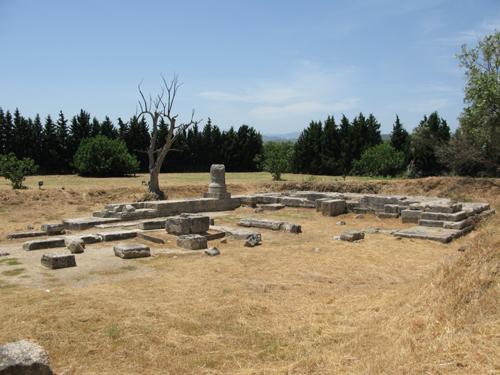
Temple of Persephone remains at Locri – from Wikimedia
I hope you enjoyed this essay on Hekate in Magna Graecia: Locri.
© Melissa McNair / The Torch and Key
Sources:
- Homer. Hymn 2 to Demeter
- MacLachlan, Bonnie. “Kore as Nymph, not Daughter: Persephone in a Locrian Cave”, http://www.stoa.org/diotima/essays/fc04/MacLachlan.html
- MacLachlan, Bonnie. “Ritual Katabasis and the Comic”, https://etudesanciennes.revues.org/909#tocto2n2
- “Locri Epizefiri”, https://it.wikipedia.org/wiki/Locri_Epizefiri
- MacLachlan, Bonnie. “Women and Nymphs at the Grotta Caruso”. Mystic Cults in Magna Graecia. University of Texas Press, 2009