Hekate in Magna Graecia: Bosco Littorio


Bosco Littorio

This location, the Greek Baths in Gela in the province of Caltanissetta, deserves a mention although information is scarce. It is situated on the southern Sicilian coast, and some curious archaeological remains were found here. Named the “archaic emporium”, the remains of three stone altars dating to approximately 6th century BCE were found. One depicted Medusa the Gorgon, the famed sea creature of Greek myths who had snakes for hair and turned anyone to stone who dared to look at her. With Medusa were her children Pegasus and Chrysaor. Another altar depicted Eos (goddess of the dawn) kidnapping Thanatos (personification of death). The third altar is showing a trio of female figures but they have yet to be positively identified. All three altars are currently on display in the Regional Archaeological Museum of Gela.

It is also worth noting that some type of catastrophic natural disaster happened here, possibly a tsunami preceded by an earthquake, around 480 BCE. Numerous shipwrecks were found in the vicinity and no archaeological remains dated from after that time have been found there.
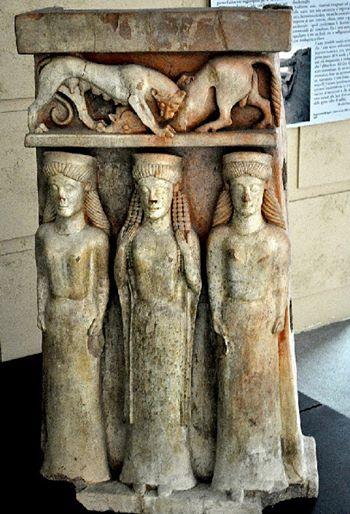
image10

Altar figure of a trio of females – Bosco Littorio – from Wikipedia


I hope you enjoyed this essay on Hekate in  Magna Graecia: Bosco Littorio.

© Melissa McNair / The Torch and Key


Source:

Hekate in Magna Graecia: Scyllaeum


Scyllaeum

Scyllaeum is another colony in Magna Graecia, and was home to the mythical sea monster Scylla (or Skylla). Scyllaeum was located in the Calabria region of Southern Italy. The Hekatean connection here is parentage. In Appollonius Rhodius Argonautica, Hekate Krataiis (epithet meaning “rocky” or “mighty”) and the sea god Phorkys were parents to the sea monster Skylla:

“Ausonian Skylla (Scylla), the wicked monster borne to Phorkys (Phorcys) by night-wandering Hekate (Hecate), whom men call Kratais (Crataeis).”

Skylla was a sea monster that haunted the rocks in the waters off the coast, and any ships that sailed too close would lose their men to one of Skylla’s many monstrous heads. Skylla was situated between the coast and a whirlpool of Kharybdis, another sea monster that threatened ships in the waters off the coast. Another passage from the Argonautica details the warnings given against Skylla and Kharybdis: 

“[Hera commands the sea-goddess Thetis to guide the Argonauts safely past Skylla (Scylla) :] ‘And do not let my friends [the Argonauts] be so unwary as to fall into Kharybdis (Charybdis), or at one gulp she will swallow them all. Nor let them go too near the hateful den of Ausonian Skylla (Scylla), the wicked monster borne to Phorkys by nigh-wandering Hekate (Hecate), whom men call Kratais (Crataeis)–or she may swoop down, take her pick and destroy them in her terrible jaws. What you must do is so to guide the ship that they escape disaster, if only by a hair’s breadth.’”

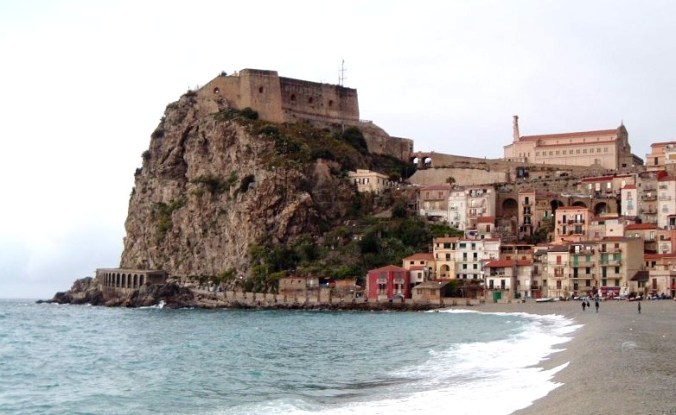
Strabo described Scyllaeum as a projecting rocky headland that juts out into the sea, joined to the mainland by an isthmus that forms a bay on each side. The village is active today and is known by the name of Scilla, and boasts a little over 5000 residents. It is primarily a fishing village, and it is also an active tourist destination.

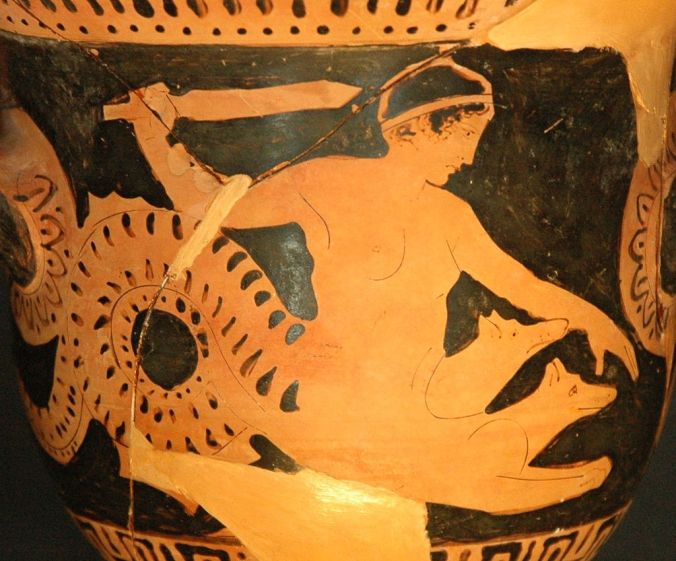
Scylla_Louvre_CA1341

Scylla as a maiden with a kētos tail and dog heads sprouting from her body. Detail from a red-figure bell-crater in the Louvre, 450–425 BCE. This form of Scylla was prevalent in ancient depictions, though very different from the description in Homer, where she is land-based and more dragon-like. Image from Wikimedia.

Castello_scilla

The Rock of Scilla, Calabria, which is said to be the home of Scylla. Image from Wikimedia.


I hope you enjoyed this essay on Hekate in  Magna Graecia: Scyllaeum.

© Melissa McNair / The Torch and Key


Sources:

Hekate in Magna Graecia: Cumae


Cumae

The Cumaean Sybil is a well-known figure in Virgil’s Aeneid, as well as one of the most well known oracles in Magna Graecia. Cumae was a Greek colony located near coastal Naples in southern Italy, belonging to Magna Graecia. The Latin word “sybil” comes from the Greek word “sibylla”, which means “prophetess”.  The Cumaean Sybil quickly became famous across southern Italy, and gained favor with Rome, with people coming from afar to hear her prophecies, much like the Delphic Oracle in Greece.

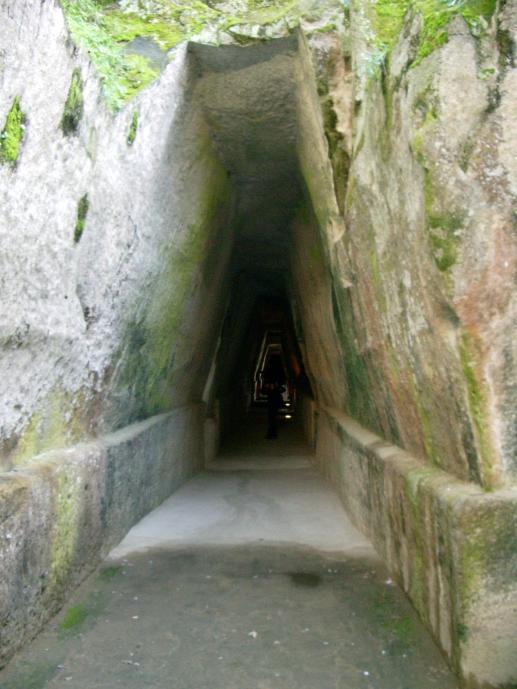
The Sybil was said to reside in a cave, and called on Hekate to enlist Her aid in necromantic rites, as written in Virgil’s Aeneid, where Aeneas was attempting to reach the underworld:

“[The Sibyl performs the rites of necromancy at the oracle of the dead at Cumae] : The Sibyl first lined up four black-skinned bullocks, poured a libation wine upon their foreheads, and then, plucking the topmost hairs from between their brows, she placed these on the altar fires as an initial offering, calling aloud upon Hecate, powerful in heaven and hell.”…..” But listen!–at the very first crack of dawn, the ground underfoot began to mutter, the woody ridges to quake, and a baying of hounds was heard through the half-light : the goddess was coming, Hecate. [A path was then opened for the Sibyl and Aeneas to journey on through the underworld.]”

The rites that the Cumaean Sybil performed to Hekate always took place within the cave in Cumae where the Sybil resided.

image11

Entrance to the cave of the Cumaean Sybil – from Wikimedia


I hope you enjoyed this essay on Hekate in  Magna Graecia: Cumae.

© Melissa McNair / The Torch and Key


Sources: