- Please see the Hekate in Magna Graecia page for more information on this project
Selinunte
Selinunte (also known as Selinus or Selinous) was a major settlement on the southwest coast of Sicily, and was believed to have been settled in the mid-6th century BCE, though the exact date remains unknown. The acropolis of Selinunte was situated between two rivers, and a major sanctuary dedicated to Demeter Malophoros was located there. This sanctuary contained several buildings within it, the largest one being Demeter’s temple. “Malophoros” (or Malophorus) is an epithet meaning “fruit-bearer”, which correlates to Demeter’s role as goddess of fertility and agriculture. The lands surrounding Selinunte were very rich and fertile, perfect for farming. Some interpret the epithet “Malophoros” as meaning either “apple bearer” or “pomegranate bearer”. “Pomegranate bearer” makes sense to me personally, considering the pomegranate fruit featured prominently in the Homeric Hymn to Demeter, which tells the story of the Rites at Eleusis. Persephone, Demeter’s daughter, ate seeds of the pomegranate fruit, which forever bound her to the Underworld.
Votive remains depicting Hekate, Demeter, and Persephone together have been found within these sanctuary remains, which is not surprising considering these three goddesses are the focus of the Eleusinian Mysteries, with Persephone’s abduction said to have taken place in Sicily according to various Sicilian cult beliefs. The worship of Hekate, Demeter, and Persephone together in Sicily is a result of Greek migration to this area, and a continuation of religious and ritual practice dating back centuries before.
The temple sanctuary featured a very large altar, stone temenos walls, and a “propylaia”, and this temple is the only one in Sicily that was constructed in such a manner and is believed to pre-date the temple style that features the tall Doric columns. One of Hekate’s many epithets is “Propylaia”, a Greek term which translates to “before the gate”. Hekate is widely known as a liminal Goddess, guarding crossroads, entryways/doorways, and other areas with a defined border, such as where grass meets forest or where sand meets the sea. The enclosed propylon had to be entered from the East, and was dedicated to Hekate, based on engraved votives found in the vicinity.
Sadly, this city was destroyed by the Carthaginians around 400 BCE and was eventually resettled, with the temples being reused. Approximately 12,000 remains of female votive figurines and defixiones (curse tablets) were also recovered in excavations of this site. These defixiones, often referred to as the “Getty Hexameters”, specifically mention Hekate by name (as well as identifying Her as Enodia), along with Persephone and Demeter. An excerpt of the words on these defixiones describes Hekate as shouting in a terrifying voice, bearing torches:
“…down from the shadowy mountains in a dark gleaming land a child brings from Persephone’s garden for milking, by necessity, the four-footed holy servant of Demeter, a nanny laden with an unceasing flow of rich milk, and she follows, trusting in the bright goddesses…torches, and Hecate Enodia, shouting a foreign-sounding shout in a terrifying voice…”
This temple appears to have been a major worship area for Selinunte, even eclipsing the Temples of Hera and Zeus, also in the same area. Archaeological evidence also suggests that Demeter’s temple was a hub of sorts for funerary rites, which fits with Hekate’s role as Psychopomp (guide of souls) and the reincarnation theme of the Eleusinian Mysteries, with Hekate, Demeter, and Persephone at the center of them.
Many of the archaeological finds from Selinunte are currently housed in the museum in Palermo, Sicily.
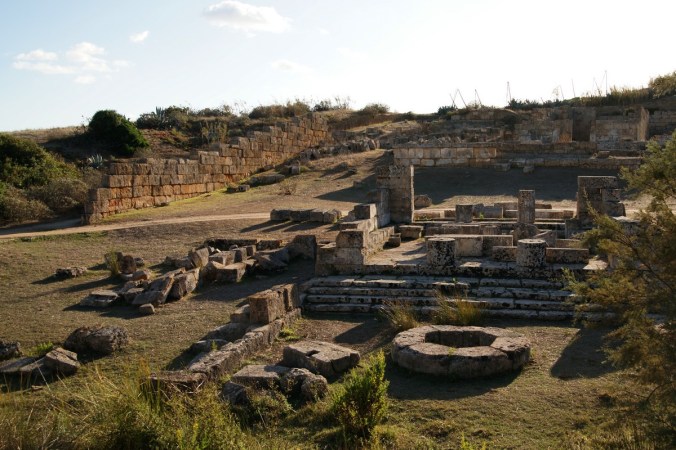
Propylon of Hekate at Temple of Demeter Malophoros – image source: Wikimedia commons
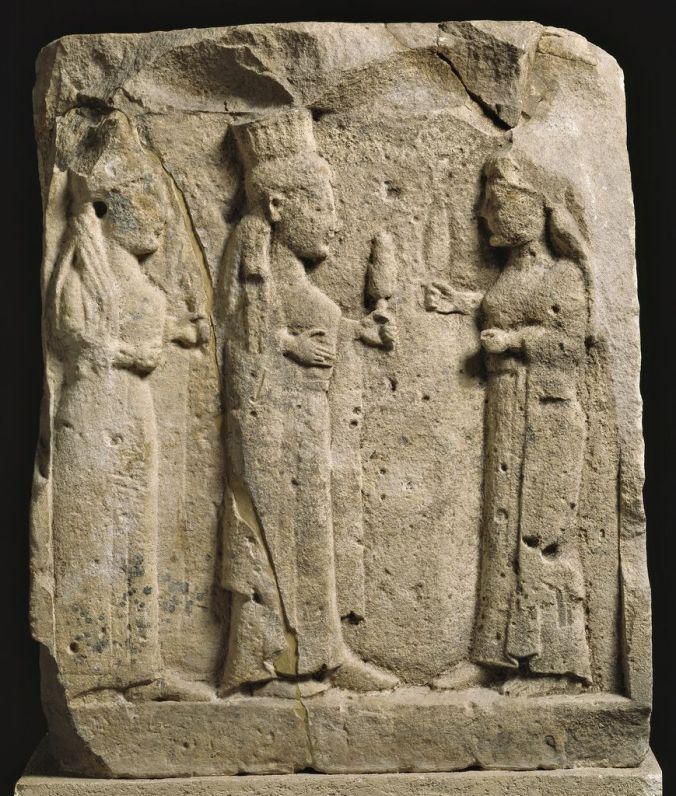
Relief of Demeter, Persephone, & Hekate – Selinunte – Palermo Archaeological Museum
I hope you enjoyed this essay on Hekate in Magna Graecia: Selinunte.
© Melissa McNair / The Torch and Key
Sources:
- http://data.perseus.org/artifacts/site/Selinus
- “Temple of Demeter at the Sanctuary of Demeter Malophoros, Selinus”, https://pleiades.stoa.org/places/502577471
- Miles, Margaret M. “The Propylon to the Sanctuary of Demeter Malophoros at Selinous.” American Journal of Archaeology, vol. 102, no. 1, 1998, pp. 35–57. JSTOR, http://www.jstor.org/stable/506136
- Lupus, P. Sufenas Virius. Ephesia Grammata: Ancient History and Modern Practice. Washington: Red Lotus Library, 2014
- Jordan, David R., and Roy D. Kotansky. “Ritual Hexameters in the Getty Museum Preliminary Edition.” Zeitschrift Für Papyrologie Und Epigraphik, vol. 178, 2011, pp. 54–62. JSTOR, http://www.jstor.org/stable/41616753

