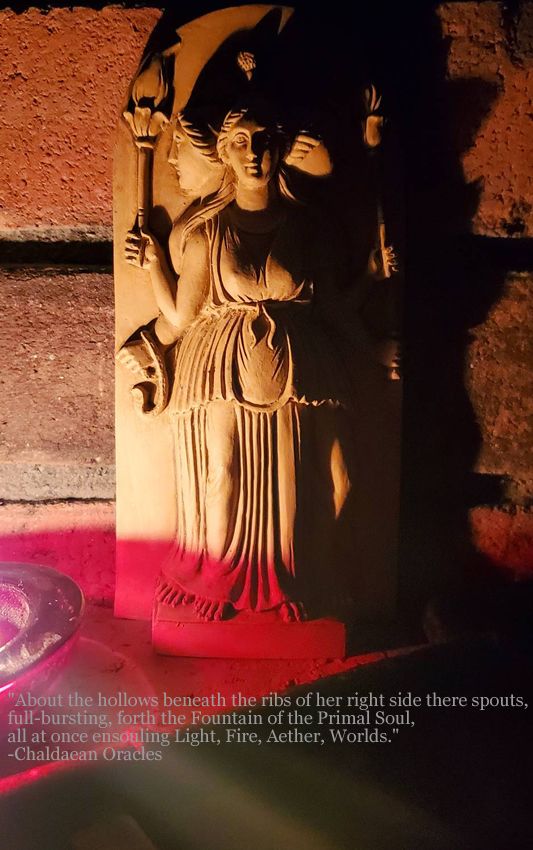
Hekate as Cosmic World Soul: Purification and Cleansing

In keeping with the Covenant of Hekate’s February theme of celebrating Hekate as Cosmic World Soul, here is another short post about ritual purification & cleansing. This is more of a personal post which includes my own purification incense blend recipe for all to use.

As most reading this will know, ritual purification of yourself and your sacred space is key when performing devotional or formal rituals. Theurgists believed in ritual purification, as evidenced in these excerpts from the Chaldean Oracles:

“The oracles of the gods declare, that, through purifying ceremonies, not the soul only, but bodies themselves become worthy of receiving much assistance and health: “for (say they) the mortal vestment of bitter matter will, by this means, be preserved.” And this, the gods, in an exhortatory manner, announce to the most holy of Theurgists.”

“The Theurgist who presides over the mystic rites of Apollo, begins his operations from purifications and sprinklings. “The priest, in the first place, governing the works of fire, must sprinkle with the cold water of the loud-sounding sea,” as the oracle says.”

I think it is incredibly important to ensure that yourself and your sacred space is purified before presenting to the gods you are honoring. I created an incense blend for purification purposes. The ingredients are basic and easily found, but the result is powerful and achieves my goal of purifying my sacred space. Plus I love the way it smells, that’s always a bonus! This incense may be burned before formal rituals, or it may be used on a regular basis for routine cleansing of your sacred space. Or both; this incense may be used however you prefer to cleanse your sacred space.

Basically, this blend consists of frankincense resins, myrrh resins, dried lavender flower buds, and dried rosemary (I included a photo below). That’s all. 4 basic ingredients. Nothing fancy, or top secret. It’s very simple to obtain and blend.

Using top-quality ingredients is very important to me personally. Frankincense and myrrh resins are readily available just about anywhere; do an internet search and the results are endless. The quality of these resins, though, can be suspect depending on the source. I personally prefer to purchase my resins from Mountain Rose Herbs. The price per pound may be a little higher than most places, but I know 100% without a doubt that they will be premium quality resins. They know where their stuff is harvested from, and that’s important, too. I am not affiliated with them in any way – I just like their offerings, and have been shopping with them for years. But use a supplier you know and trust. When buying myrrh, be sure to purchase pure myrrh resins – not the opopanax variety. It’s a slightly different variation of myrrh that is less expensive and (in my opinion) a lesser quality. For the rosemary, you can find that easily in your local market where the fresh herbs are or you can buy them already dried. Same for the dried lavender, though there are plenty of online resources for those too (such as bulk spice importers, or Mountain Rose as well).


incense

Photo © Melissa McNair / The Torch and Key

To create this blend, crush the frankincense and myrrh resins with your mortar and pestle until they are in small pieces and try to have them uniform in size as best as you are able to manage. Use equal amounts of both. Once the resins are crushed to your liking, add the lavender and blend well. Then add the rosemary and blend well. I don’t measure anything when making incense… it sounds odd, I know, but I just eyeball everything and if it feels right, then I will leave it. Or, I will add a little more if I feel it needs a bit more. I never start out with too much, because you can always start with a little and add as needed, but you can’t take away if you add too much at first. You will just end up adding more of everything else to compensate and then end up with an enormous amount of incense that you won’t know what to do with. (been there!) Also, lavender has a pretty powerful aroma – try not to use too much of it.

Once you are satisfied with your blend, store any extra in a glass jar or an airtight container, out of sunlight.

I hope you enjoyed this little essay and if you decide to try this incense – I hope you enjoy that, too!


Honoring Hekate in February

As mentioned earlier, the Covenant of Hekate is celebrating and honoring Hekate as Cosmic World Soul for the entire month of February. A hashtag of #hekateworldsoul is being added to all public projects, so if you are on Twitter, Instagram, Facebook, or any other medium that utilizes hashtags, you may find these other works by searching #hekateworldsoul . Also, if you feel inspired to share your own experiences, be sure to include the hashtag so others can find you.


For Hekate as the Cosmic World Soul, February 2018 – a CoH devotional project – www.hekatecovenant.com

© 2018 The Torch and Key / Melissa McNair

Hekate in Magna Graecia: Selinunte

Selinunte

Selinunte (also known as Selinus or Selinous) was a major settlement on the southwest coast of Sicily, and was believed to have been settled in the mid-6th century BCE, though the exact date remains unknown. The acropolis of Selinunte was situated between two rivers, and a major sanctuary dedicated to Demeter Malophoros was located there. This sanctuary contained several buildings within it, the largest one being Demeter’s temple. “Malophoros” (or Malophorus) is an epithet meaning “fruit-bearer”, which correlates to Demeter’s role as goddess of fertility and agriculture. The lands surrounding Selinunte were very rich and fertile, perfect for farming. Some interpret the epithet “Malophoros” as meaning either “apple bearer” or “pomegranate bearer”. “Pomegranate bearer” makes sense to me personally, considering the pomegranate fruit featured prominently in the Homeric Hymn to Demeter, which tells the story of the Rites at Eleusis. Persephone, Demeter’s daughter, ate seeds of the pomegranate fruit, which forever bound her to the Underworld.

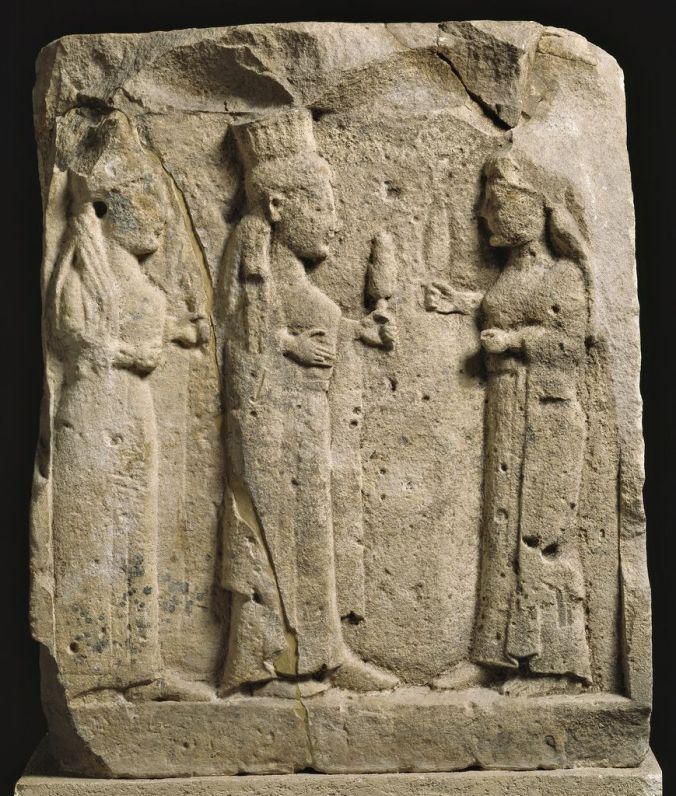
Votive remains depicting Hekate, Demeter, and Persephone together have been found within these sanctuary remains, which is not surprising considering these three goddesses are the focus of the Eleusinian Mysteries, with Persephone’s abduction said to have taken place in Sicily according to various Sicilian cult beliefs. The worship of Hekate, Demeter, and Persephone together in Sicily is a result of Greek migration to this area, and a continuation of religious and ritual practice dating back centuries before.

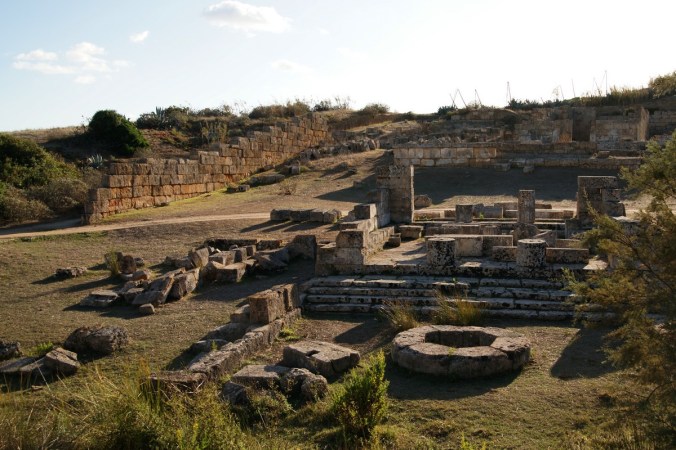
The temple sanctuary featured a very large altar, stone temenos walls, and a “propylaia”, and this temple is the only one in Sicily that was constructed in such a manner and is believed to pre-date the temple style that features the tall Doric columns. One of Hekate’s many epithets is “Propylaia”, a Greek term which translates to “before the gate”. Hekate is widely known as a liminal Goddess, guarding crossroads, entryways/doorways, and other areas with a defined border, such as where grass meets forest or where sand meets the sea. The enclosed propylon had to be entered from the East, and was dedicated to Hekate, based on engraved votives found in the vicinity.

Sadly, this city was destroyed by the Carthaginians around 400 BCE and was eventually resettled, with the temples being reused. Approximately 12,000 remains of female votive figurines and defixiones (curse tablets) were also recovered in excavations of this site.  These defixiones, often referred to as the “Getty Hexameters”, specifically mention Hekate by name (as well as identifying Her as Enodia), along with Persephone and Demeter. An excerpt of the words on these defixiones describes Hekate as shouting in a terrifying voice, bearing torches:

“…down from the shadowy mountains in a dark gleaming land a child brings from Persephone’s garden for milking, by necessity, the four-footed holy servant of Demeter, a nanny laden with an unceasing flow of rich milk, and she follows, trusting in the bright goddesses…torches, and Hecate Enodia, shouting a foreign-sounding shout in a terrifying voice…”

This temple appears to have been a major worship area for Selinunte, even eclipsing the Temples of Hera and Zeus, also in the same area. Archaeological evidence also suggests that Demeter’s temple was a hub of sorts for funerary rites, which fits with Hekate’s role as Psychopomp (guide of souls) and the reincarnation theme of the Eleusinian Mysteries, with Hekate, Demeter, and Persephone at the center of them.

Many of the archaeological finds from Selinunte are currently housed in the museum in Palermo, Sicily.
Selinunte-demeter-malaphoros

Propylon of Hekate at Temple of Demeter Malophoros – image source: Wikimedia commons
66bdb8310ffb35c600fe4ae90ad55533

Relief of Demeter, Persephone, & Hekate – Selinunte – Palermo Archaeological Museum


I hope you enjoyed this essay on Hekate in  Magna Graecia: Selinunte.

© Melissa McNair / The Torch and Key


Sources:

Hekate as Cosmic World Soul

Within the Covenant of Hekate, we celebrate and honor Hekate’s many different forms. Her identity as Cosmic World Soul and Soteira is, however, the root of our work within the CoH.

The Covenant of Hekate is dedicating February 2018 to Hekate as Cosmic World Soul, and members are collaborating on a devotional project that includes poetry, artwork, personal stories, and rituals inspired by Hekate as Soteira. This is my contribution; please feel free to share this blog post with a link back here.

What does “Cosmic World Soul” mean?

In the Chaldean Oracles, Hekate is irrevocably defined as the Cosmic World Soul – the Great Mother, the Anima Mundi, Creatrix of All. The source of primordial fire.

I have experienced many different sides to Hekate over the years, but the one that I “feel” the most is Hekate as this Great Mother; as one who facilitates life, death, rebirth, and everything in between. This excerpt from the Chaldean Oracles sums it up well, and the accompanying text (version from G.R.S. Mead), describes Hekate as “Great Mother/Magna Mater”, “Life of the Universe”, “Mother of Souls”, “Inbreather of Life”.

45

“About the hollows beneath the ribs of her right side there spouts, full-bursting, forth the Fountain of the Primal Soul, all at once ensouling Light, Fire, Aether, Worlds.”

47

“After the Father’s Thinkings, you must know, I, the Soul, dwell, making all things to live by Heat.”

In the Chaldean Oracles, the “Father” is described as existing as intellect or pure thought, while Hekate, as the Anima Mundi, puts forth his thoughts through creation.

During my personal devotionals, I often feel Hekate’s presence as this warm, glowing light. It’s hard to describe – but I when I feel Her presence in this way, I feel an abundance of Love. It is so pure; it’s hard to put into words. There were a few times where I actually witnessed a warm, golden glow appear around me. It is a very emotional and powerful experience; and very real. It doesn’t always happen. But when it does, I will most definitely bask in this sacred glow and honor Her radiance.

I also feel Her presence in this way every May Full Moon when I perform the annual Rite of Her Sacred Fires. This global rite honoring Hekate is always a wonderful experience; knowing that thousands of others from across the globe are celebrating the same rite at (more or less) the same time for the same purpose is it’s own special kind of magic.

worldsoul

Photo © Melissa McNair / The Torch and Key

Honoring Hekate in February

As mentioned earlier, the Covenant of Hekate is celebrating and honoring Hekate as Cosmic World Soul for the entire month of February. A hashtag of #hekateworldsoul is being added to all public projects, so if you are on Twitter, Instagram, Facebook, or any other medium that utilizes hashtags, you may find these other works by searching #hekateworldsoul . Also, if you feel inspired to share your own experiences, be sure to include the hashtag so others can find you.


For Hekate as the Cosmic World Soul, February 2018 – a CoH devotional project – www.hekatecovenant.com

© 2018 The Torch and Key / Melissa McNair

Hekate in Magna Graecia: An Introduction

Hekate had many cults throughout the ancient Greek and Roman world, scattered between Greece, Italy, Turkey, and possibly beyond. These essays will focus on Her known connections in Magna Graecia, with each month featuring a different colony. But first, a small bit of history.

Magna Graecia was the name given by the Romans to the coastal areas of Southern Italy in the present-day regions of CampaniaApuliaBasilicataCalabria and Sicily. Magna Graecia is Latin for “Great Greece” (Greek: Μεγάλη Ἑλλάς, Megálē Hellás). This area of Southern Italy has a very rich and diverse history. Due to it’s location in the Mediterranean Ocean, it has attracted people from all over the region and the island of Sicily was conquered by many different nations in the past. Many will be surprised to learn that those who are from modern-day Southern Italy/Sicily will have traces of ethnic origins from areas in the Middle East, Turkey, and North Africa.

Greeks began to settle in southern Italy in the 8th and 7th centuries BCE, with the hopes of finding a new life after leaving Greece for various reasons, including famine, new coastal job opportunities, or they were exiled from their homeland. Due to the heavy influx of Greek citizens into Magna Graecia, Hellenic culture quickly followed. Religion, language/dialect, and Greek civilization took root and flourished there. Some major and powerful Hellenic settlements in Magna Graecia included the following locations in Sicily: Segesta (my family is from that region, specifically Scopello and Castellamare del Golfo), Syracuse, Agrigento/Akragas, Selinunte; and in Southern mainland Italy there is Cumae and Kroton – all on or near the coast. Preserved archaeological remains in these cities are a testament to a bygone era of Hellenic civilization in Southern Italy, and to this day they attract thousands of tourists from around the world.

This research is very personal for me; I am a third generation Sicilian-American and my grandparents were born and raised in a small village on the northern coast of Sicily. They are from the region that was Segesta, a major Greek colony belonging to the Elymians, who were one of three indigenous peoples of Sicily. My family began immigrating to America after the end of the Second World War, with many of them arriving by the late 1970s. Most have stayed behind and remain in Sicily today (with some settling on the island of Sardegna).

A bit of a disclaimer before we delve into Hekate’s presence in southern Italy: these essays are by no means exhaustive; there is a lot that remains unknown as to the finer details of cult worship as outlined below. There really isn’t much to go on apart from the archaeological remains that have been found to date and thoroughly examined. Written records are rare; all we have are fragments written by historians from antiquity such as Strabo and Diodorus Siculus (and others). These remains and the scattered written fragments of history are the only clues we have with regards to ritual practices and worship in ancient times. The Eleusinian Mysteries were re-enacted in Sicily after temples and sanctuaries were established for Demeter, Persephone, and Hekate. Cult worship of Demeter and Persephone was widespread across Sicily. Many of you reading this may already know that the Eleusinian Mysteries were highly secretive; participants were sworn to secrecy and were not allowed to discuss the rites with non-initiates, and as a result there is virtually no written record of them.

I have no doubt that there are many areas where archaeological remains in Sicily are buried and have yet to be discovered. I am not a professional scholar; I am just a devotee of Hekate who also honors Demeter and Persephone – the holy triad of the Eleusinian goddesses. Hekate appeared in my life and claimed me in March of 2010, and I have spent much of my time since then researching and studying historical practices as related to them and ancient Hellenic rituals in general. I have devoted a good portion of that time studying Hekate’s presence in Magna Graecia; many references to Hekate in this region are, unfortunately, obscure and I did my best to piece together what wasn’t so obvious based on my own knowledge and other historical data. My hope is that these essays will light a fire within you and inspire you to explore these ancient sites in Sicily and southern Italy and beyond, and to try and piece together Hekate’s living history of worship. Hekate is a multi-faceted goddess who transcends cultures and geographical locations.

Editorial note: throughout these essays I often refer to Hekate using the pronouns “She” or “Her”. I have written these words beginning with a capital letter as a sign of honor and respect.

The February essay that will be shared will discuss the remains found in the colony of Selinunte, located on the southwest coast of Sicily. I do hope that you will find these essays informative and enjoyable. If you would like notifications of new posts, be sure to subscribe to my blog either directly through WordPress if you have an account, or via email (both subscribe options may be found on the blog home page).


© Melissa McNair / The Torch and Key. All rights reserved.