I really enjoy searching and reading academic papers about Hekate, and ancient Roman / Greek religious – cult practices in the ancient world. These papers aren’t usually widely circulated, and the hard work and time scholars put into researching and writing these papers often, sadly, go unnoticed.
I came across this paper I am linking here quite by happy accident, and I am so glad I found it. It is titled “Hekate in Lagina: a goddess performing her civic duty” written by Dr. Amanda Herring. The link leads to a landing page from Cambridge University, and this paper was included in their Anatolian Journal from August 2022. The PDF version of the paper must be downloaded in order to read it.
This paper delves into the cult of Hekate at Lagina / Stratonikeia in modern day Turkey. Here is a copied and pasted summary:
“The Hellenistic Sanctuary of Hekate at Lagina represents the only site at which Hekate received state-sponsored cult at a monumental temple and a privileged place in the local pantheon. Elsewhere in Karia and the wider Greek world, Hekate was associated with magic and the underworld and received personal dedications at doorways and crossroads. This portrayal was echoed in art, where her character manifested in her triple-bodied form. Yet, at Lagina, part of the city of Stratonikeia, she was always represented with a single body. She was the focus of civic cult, in particular during the Hekatesia-Romaia festival, which celebrated the political alliance between Stratonikeia and Rome. Through an analysis of inscriptions, representations of the goddess in sculpture and coins, and the ritual use of the complex, this article concludes that Hekate of Lagina was a syncretic and singular figure who did not exist outside of Stratonikeia, and that her function at Lagina was primarily political, as a civic patron. As a goddess who oversaw life’s transitions and acted as a saviour of her people, she was uniquely suited to the role. The goddess and her sanctuary were used by the local population to create community identities and to negotiate their relationships with the wider world, particularly their imperial rulers.“
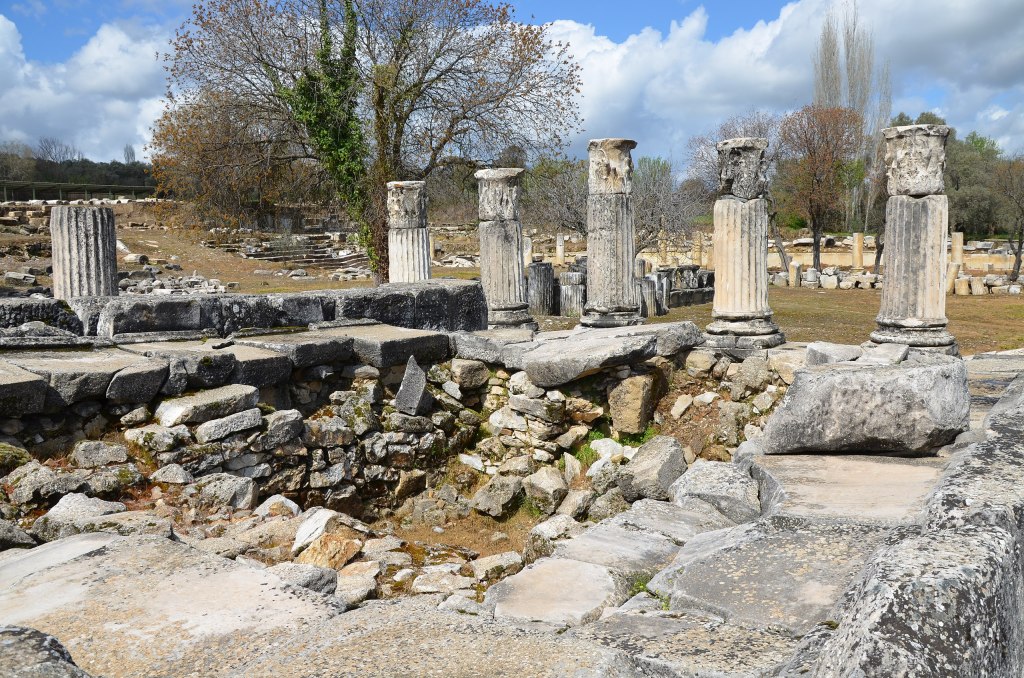
The Sanctuary of Hekate in Lagina, Caria, Turkey. Photo from Wikipedia