I really enjoy searching and reading academic papers about Hekate, and ancient Roman / Greek religious – cult practices in the ancient world. These papers aren’t usually widely circulated, and the hard work and time scholars put into researching and writing these papers often, sadly, go unnoticed.
I came across this paper I am linking here quite by happy accident, and I am so glad I found it. It is titled “Hekate in Lagina: a goddess performing her civic duty” written by Dr. Amanda Herring. The link leads to a landing page from Cambridge University, and this paper was included in their Anatolian Journal from August 2022. The PDF version of the paper must be downloaded in order to read it.
This paper delves into the cult of Hekate at Lagina / Stratonikeia in modern day Turkey. Here is a copied and pasted summary:
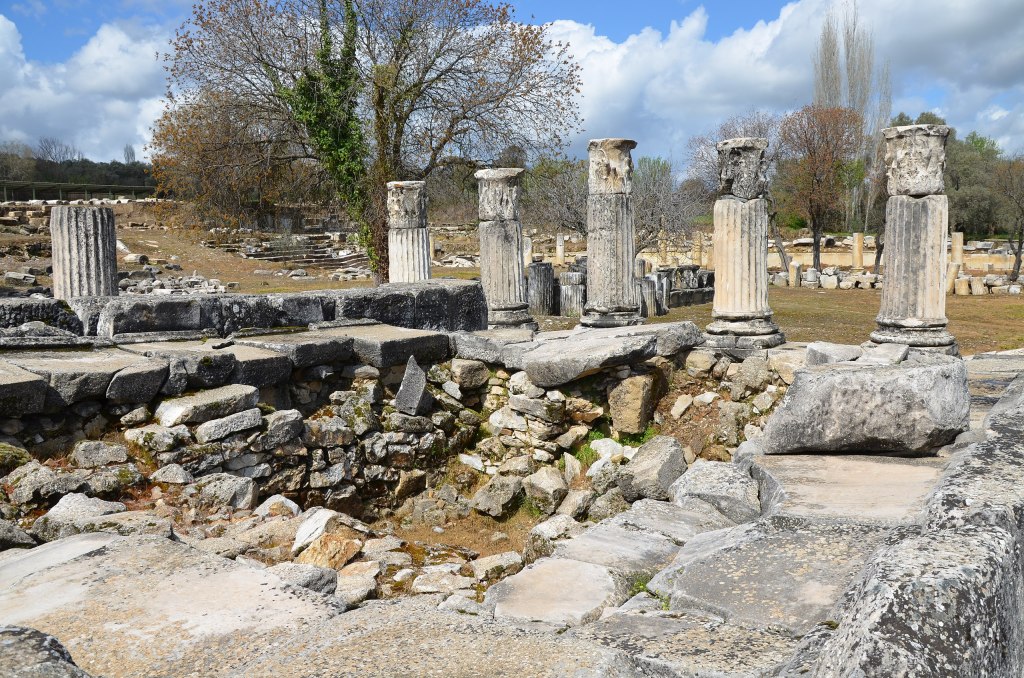
“The Hellenistic Sanctuary of Hekate at Lagina represents the only site at which Hekate received state-sponsored cult at a monumental temple and a privileged place in the local pantheon. Elsewhere in Karia and the wider Greek world, Hekate was associated with magic and the underworld and received personal dedications at doorways and crossroads. This portrayal was echoed in art, where her character manifested in her triple-bodied form. Yet, at Lagina, part of the city of Stratonikeia, she was always represented with a single body. She was the focus of civic cult, in particular during the Hekatesia-Romaia festival, which celebrated the political alliance between Stratonikeia and Rome. Through an analysis of inscriptions, representations of the goddess in sculpture and coins, and the ritual use of the complex, this article concludes that Hekate of Lagina was a syncretic and singular figure who did not exist outside of Stratonikeia, and that her function at Lagina was primarily political, as a civic patron. As a goddess who oversaw life’s transitions and acted as a saviour of her people, she was uniquely suited to the role. The goddess and her sanctuary were used by the local population to create community identities and to negotiate their relationships with the wider world, particularly their imperial rulers.“
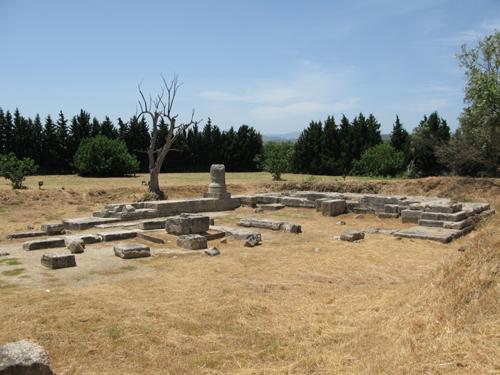
The Sanctuary of Hekate in Lagina, Caria, Turkey. Photo from Wikipedia
Morgantina was a province in Enna, Sicily, which is roughly in the east-center of the island. Morgantina was settled sometime around 1000 BCE and life continued there until around 50 CE. In present day, the area is known as “Aidone”. Morgantina was the site of a major sanctuary to Demeter and Persephone, and many statues, votives, pottery, and curse tablets have so far been recovered at the site. Sadly, much looting was done here and artifacts are still being recovered and returned to Italy in present-day.
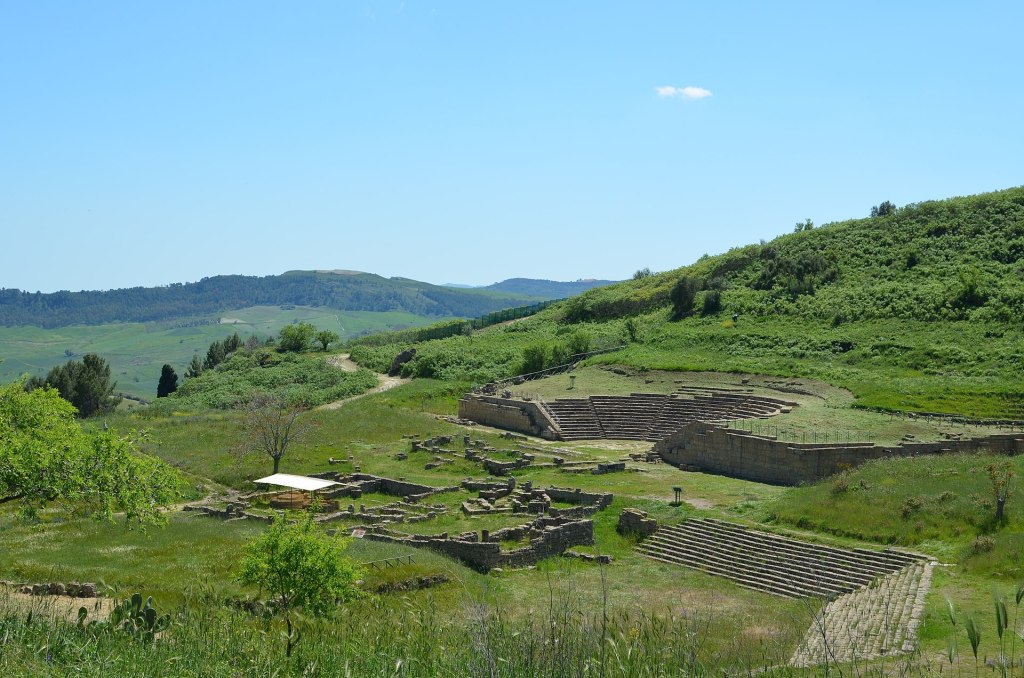
Remains of the sanctuary of Demeter & Persephone, and a Greek theater beyond the sanctuary. Image from Wikimedia Commons
Morgantina was home to a major sanctuary dedicated to Demeter and Persephone, the excavated remains of one may be seen in the above photo. Researchers discovered that there were actually five separate sanctuaries in Morgantina dedicated to Demeter and Persephone, and each one likely served different functions. They were located on each directional side (north, south, east, and west). Morgantina is near Pergusa, which is where Persephone was abducted by Hades. A main sanctuary, referred to as the “thesmophorion” to celebrate the Eleusinian mysteries, comprised of several different rooms, some of which were believed to be living quarters for the temple priestesses. Many different votive offerings were found surrounding the altars, and they mostly consisted of figurines and vases. Also found at the site were statues & busts of the goddesses, ritual clay lamps, and hair accessories. Some of the statues found show Persephone holding a piglet and torches. Other artifacts were found within the sanctuary, including items used for pressing oil and wine, and for grinding corn and other grains.
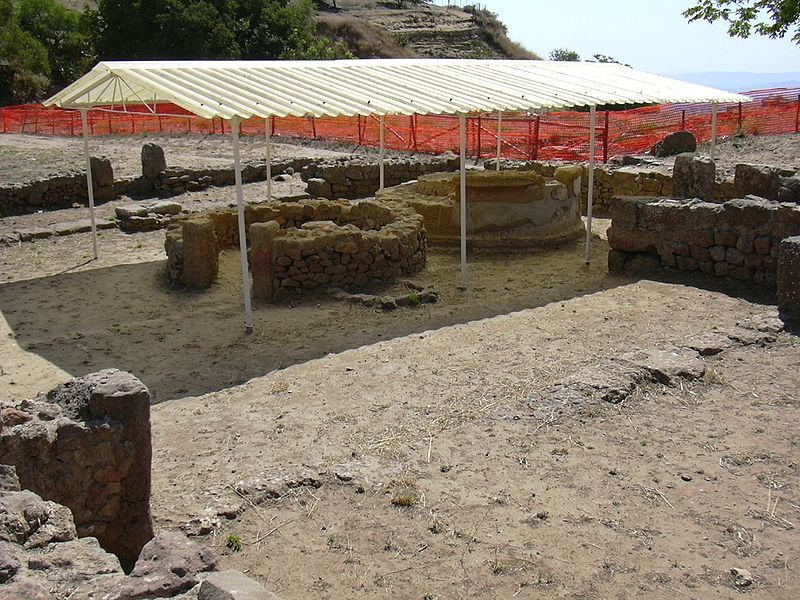
As seen in other sanctuaries to Demeter and Persephone, the main sanctuary at Morgantina has a propylon dedicated to a Chthonian goddess, possibly Hekate or Persephone. This propylon contains a pit in the ground for offerings (a “botros”), and a cylindrical stone altar. Animal bones (likely from pigs) and pottery votive offerings have been found within the botros.
Propylon dedicated to a Chthonian goddess, showing a round altar and botros (offering pit). Public domain image from Wikipedia
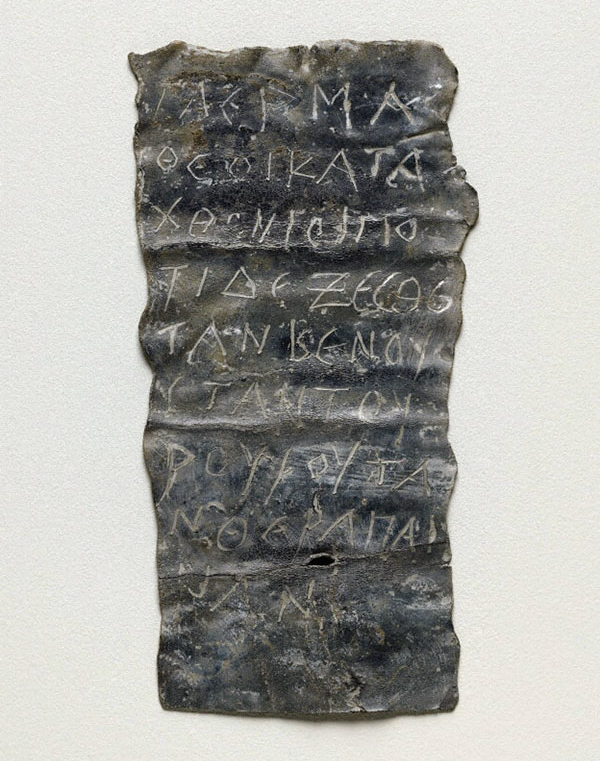
Several lead curse tablets have also been found at Morgantina, and most have been unearthed from the offering pit in the sanctuary / propylon to the still-unnamed Chthonian goddess. One tablet, pictured below, is part of a group of four tablets all cursing a slave named Venusta, and asking the gods of the Underworld to take her to their realm of the dead.
Curse Tablet, about 100 B.C., found in Morgantina, Sicily. Lead, 3 11/16 x 1 13/16 in. (9.4 x 4.6 cm). Museo Archeologico Regionale of Aidone. Photo from Getty Images.
I hope you enjoyed this short essay on Hekate in Magna Graecia: Morgantina. I will expand on this specific topic of Morgantina in the future.
Exploring the Misteri di Trapani and Demeter’s Search for Persephone
Trapani (sometimes referred to as “Drepana”) is a city on the northwest tip of Sicily, and was founded by the Elymians approximately 3rd century BCE. There are a few legends as to the founding of Trapani (near Eryx / Erice), and one of them involves Demeter’s search for Persephone after her abduction by Hades. According to the legend, Demeter dropped her sickle while searching for Persephone, which would explain why the coastal land resembles the curved blade of a sickle.
Sicily was once known as Magna Graecia, and the echoes of that past are evident just about everywhere you go on that magical island. Even though Catholicism became the dominant religion in Italy, the “old ways” were kept by rural peasants especially in Sicily, and were disguised as Catholic to keep up appearances. One such practice is the veneration of the Black Madonna. The Catholic Church has a simplistic explanation for Black Madonnas – mostly that the statues / icons of the Virgin Mary “aged” over the years, darkening the coloring of the icon. But those who know, know that the Black Madonna is the divine feminine – a concept carried over from the old ways. We know Her by many names: Dark Mother, Demeter, Melaina, etc. The Catholic Virgin and Child is said by many to actually represent Demeter and Persephone, especially in Sicily where the Eleusinian Mysteries were carried out long ago in places like Selinunte and Locri. The story of Demeter and Persephone – from Persephone’s abduction to Demeter’s search for her – has been kept alive in Sicily in various ways, and one can find echoes of that in the annual Easter procession in Trapani.
Misteri
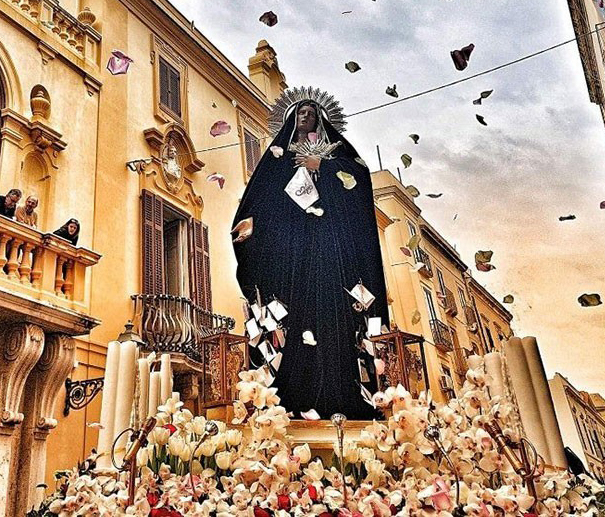
The Procession of the Mysteries in Trapani started over 400 years ago and people come from far and wide to witness this event every year. Near the end of Holy Week, on Good Friday (as of this writing in 2022 that day falls on April 15th), the procession begins with many floats depicting the passion and death of Christ. Each statue represents each station of the cross along the Via Dolorosa (“sorrowful road”), and the statues are usually crafted by local artisan guilds. In Trapani, there are two processions for the Holy Mother: an official church procession for the “white” Madonna Addolorata (“sorrowful mother”); and a second procession of the Black Madonna – the divine feminine.
Many women of Sicily, to the dismay of the Catholic church, have always venerated the Black Madonna, sometimes in secret. To these women, the Black Madonna represents the divine feminine presence in all women and creation; the powerful Earth Mother whose blackness represents the dark, fecund earth and fertility. Simply, the Black Madonna is the protectress of the poor and marginalized people of society, and is called upon for social justice and righting wrongs. She is also the Dark Mother; the powerful force of life, death, and rebirth.
With the traditional Good Friday procession that includes the Madonna Addolorata, the statues of the son and mother separate at the beginning before the son begins the way of the cross that leads to his death. This is a solemn procession, with the mother cloaked in her dark mantle desperately searching for her beloved son. This scene transcends religions and cultures and is such a powerful display that evokes ancient, ancestral memories. During these mysteries, the statue of the Madonna is joined by a statue of John the evangelist (a saint, believed by some to be one of the Apostles), and they are carried all over town in search of the son. The Holy Week mysteries come to a conclusion on Easter Sunday, when the son is resurrected/reborn and reunited with his mother.
Madonna Addolorata, photo by Processione dei Misteri di Trapani
Eleusinia
Trapani is not that far from Enna, where according to Sicilian lore Persephone was abducted by Hades on the shores of Lake Pergusa while she was picking flowers with her maidens. The story of Persephone’s abduction and Demeter’s search for her is told in the Homeric Hymn to Demeter. Hekate assisted Demeter in her search for Persephone, with her torches illuminating the way. During this time, Demeter caused all crops to wither and trees and flowers went dormant while Persephone was in the underworld with Hades. Eventually, Demeter and Persephone were reunited after Zeus intervened and tasked Hermes the Messenger to mediate between Demeter and Hades to make arrangements for Persephone’s return. Hades tricked Persephone into eating pomegranate seeds, forever binding her to the underworld. Hekate then became Persephone’s torch-bearing guide on her travels between the realms in the spring and autumn. The Eleusinian Mysteries celebrated the mysteries of life, death, and rebirth.
The Madonna’s search for her beloved son is similar to Demeter’s search for Persephone. Both mother figures are experiencing pain and a deep, aching dread. Their searches are wrought with sorrow, frustration, and grief. One may say, when witnessing the procession of the Madonna Addolorata cloaked in her dark mantle, that she held a quiet rage within her. Rage for being separated from her child, and rage for wanting justice.
Demeter’s grief over losing Persephone eventually turned to rage, when she caused all crops, plants, flowers, and trees to wither and die while she was searching for her daughter. She decreed the lands to be eternally barren while separated from her beloved Persephone. In the Homeric Hymn to Demeter, she is described as being veiled (“Kyanopeplos”), not unlike the Madonna, during her search for Persephone:
“Bitter pain seized her heart, and she rent the covering upon her divine hair with her dear hands: her dark cloak she cast down from both her shoulders and sped, like a wild-bird, over the firm land and yielding sea, seeking her child.”
“[Demeter mourning Persephone] walked behind . . . with her head veiled and wearing a dark cloak which waved about the slender feet of the goddess . . . “
Homeric Hymn 2 to Demeter
The ancient Greeks associated this myth with the changing of the seasons from summer to dormant autumn with her abduction, and Persephone’s return to the world of the living with the return of spring. To this day, many Sicilians living on country farms make offerings to Demeter for bountiful harvests and express their gratitude for their prosperity and abundance during the growing seasons.
I hope you enjoyed this short blog post about the magical Misteri, and that it has perhaps inspired you to delve into the mysteries of the Black Madonna and her connections to Demeter and Hekate. Sicily is forever in my heart, my soul, and in my bones. It is my ancestral land; the history, the lore, the ancient memories are etched within me. I have been a devotee of Hekate for many years, and Demeter and Persephone are close to my heart as well.
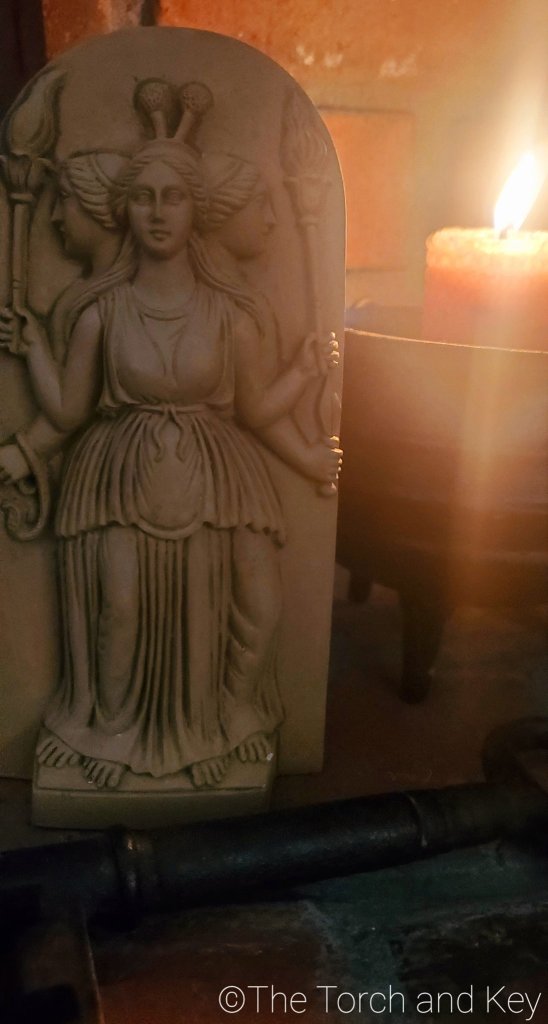
One of Hekate’s roles is that of Phosphoros – “Lightbringer” or “Lightbearer”. Hekate’s torches illuminate that which is dark. She leads the way, torch in hand, for those who have heeded Her call to immerse themselves in Her mysteries. Hekate’s torches also illuminate Truth by banishing ignorance and fear that breeds in the dark. That illumination can sometimes be a difficult and life changing process. There is a saying among many Hekateans: “En Erebos Phos” – “In darkness, there is light”. Darkness cannot exist without light, and light cannot exist without darkness. For me, Hekate Phosphoros embodies that concept.
On this Equinox and another turn of the wheel, we in the Northern Hemisphere are celebrating Spring and the ever-growing light as we progress to brighter and longer days. In the Southern Hemisphere, Autumn has descended and the days are growing shorter and darker. Wherever you are in the world, we are all experiencing that balance of light and dark in this moment. Hekate as Anima Mundi stands at the crossroads of the universe – a place of balance.
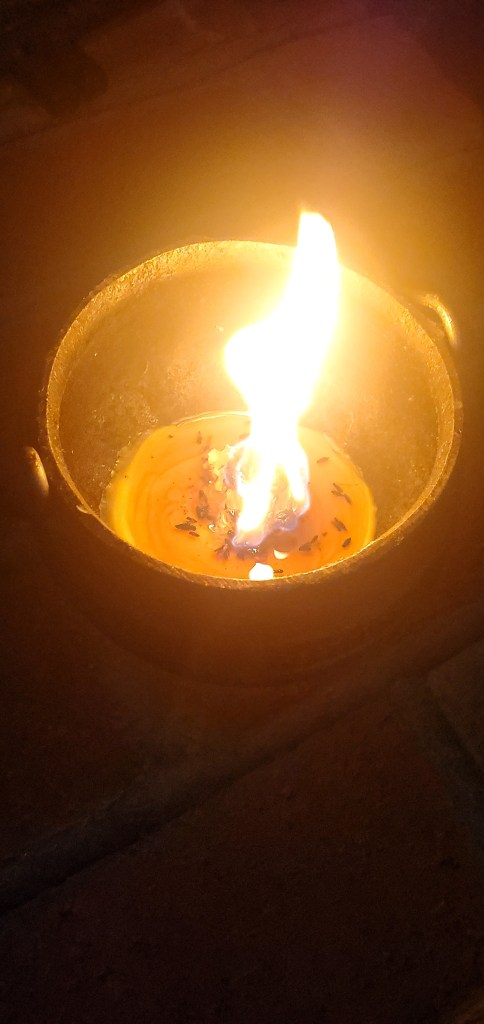
Today, I celebrated the return of Spring in a simple yet meaningful ritual. I made a beeswax candle using an ethically crafted beeswax sheet and rolled it up with dried organic lavender buds and a eco-friendly cotton wick. I decided to burn this candle completely in my mini cast iron cauldron, and I’m glad I did because once it neared the bottom, the sacred fire came alive, becoming enlarged and beautiful (see above photo). I sang praise to Hekate, honoring Her role as Phosphoros and Anima Mundi.
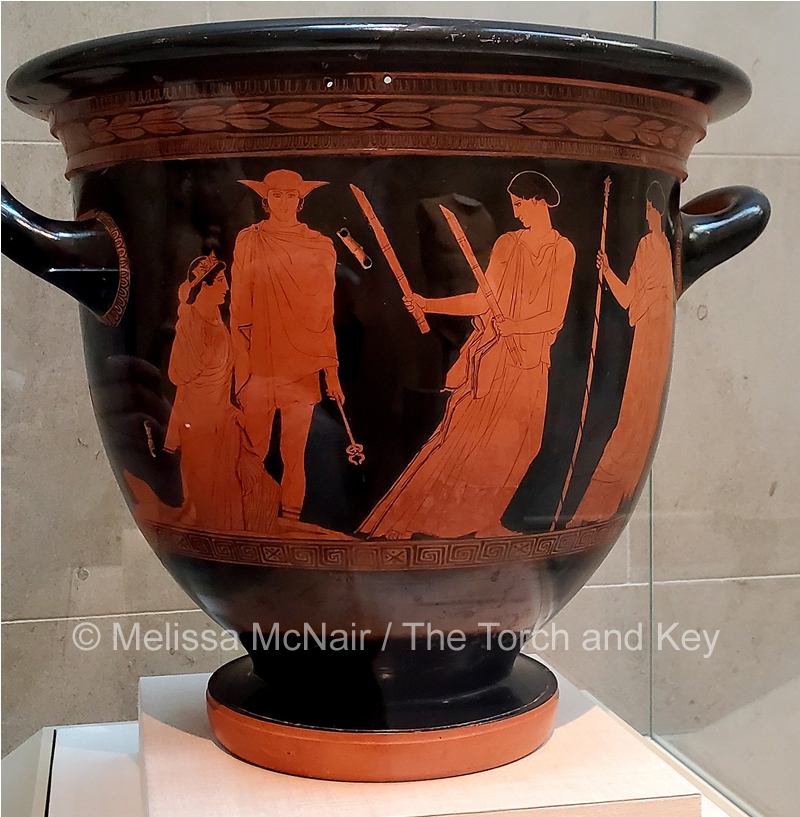
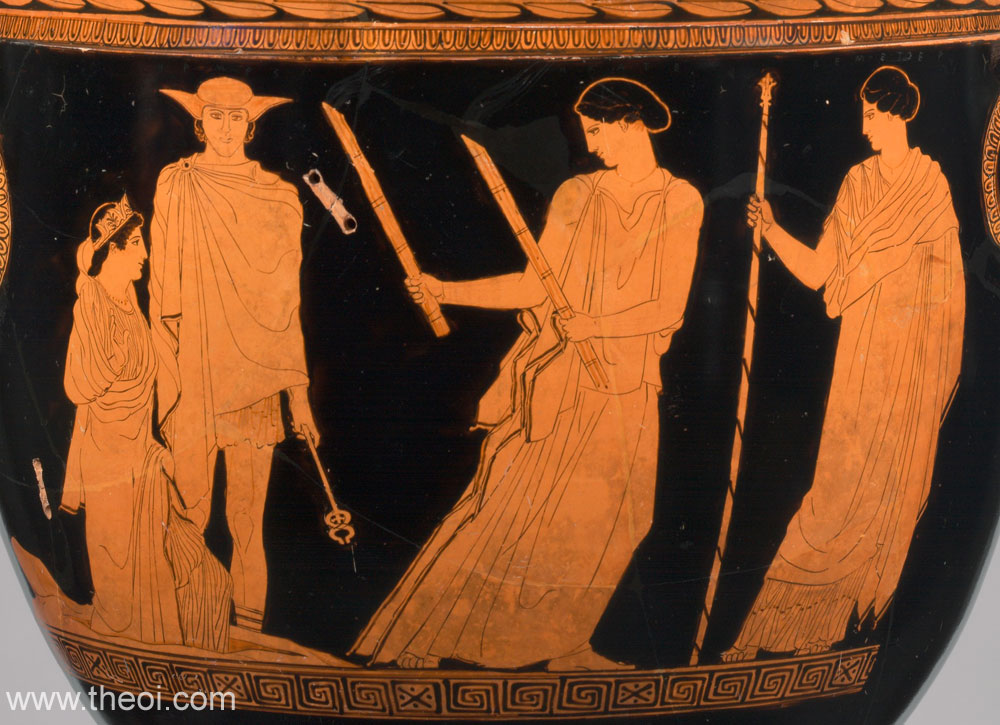
“The Return of Persephone”, Attic vase dated circa 440 BCE
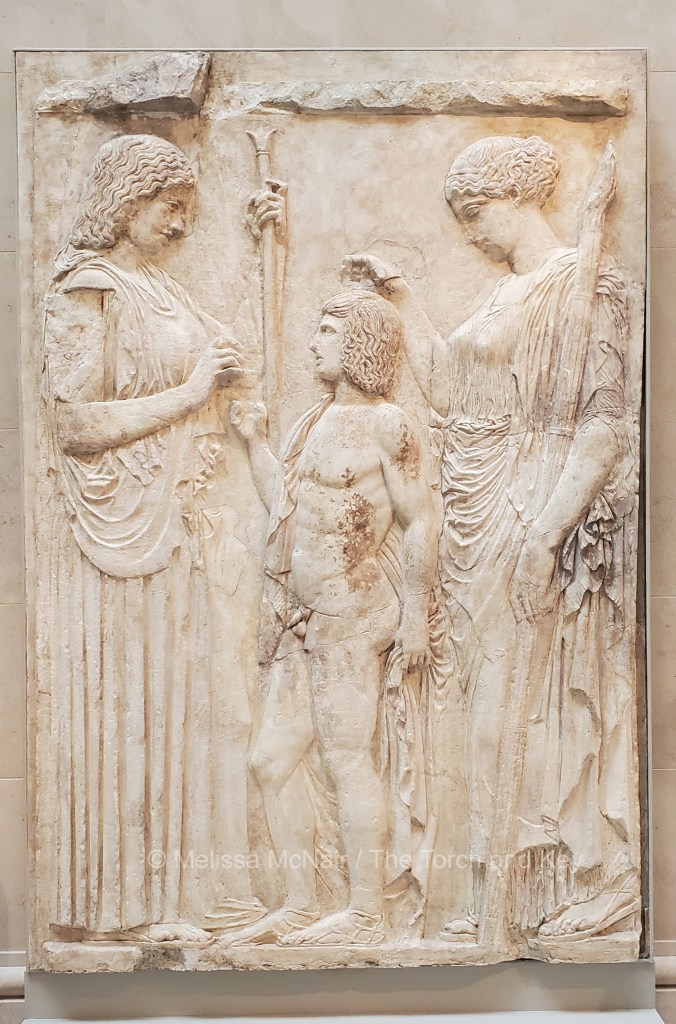
Spring is traditionally a time of rebirth and renewal. The Earth is awakening from her winter slumber, and life is beginning to stir in both flora and fauna. The return of Spring also brings the return of Persephone from the Eleusinian Mysteries. The Rites of Eleusis were initiatory mysteries taking place in the autumn and spring, marking the descent of Persephone into the realm of the dead with her consort Hades (autumn), and Persephone’s return to the mortal world above to be reunited with her mother Demeter (spring). (see related blog post regarding Enna in Sicily).
Hekate had an integral role in these mysteries, acting as Persephone’s companion and guide during both her descent and return. Much isn’t known about the Eleusinian Mysteries, but scholars agree that it centered on the concept of life, death, and rebirth. The Eleusinian Mysteries were tied to the agricultural season of the Mediterranean region, and the mysteries were used to help explain the seasonal changes of growth and life, death and decay, and regeneration of that which died.
Hekate is a liminal goddess that straddles the realms of these forces with ease. Demeter represents life, Persephone represents death and rebirth, and Hekate as Creatrix weaves these energies together. All three goddesses were honored during these rites.
The image above is from a vase dated back to 440 BCE. It shows Persephone, on the left, returning from the realm of Hades. Hermes is standing next to Persephone, and Demeter is on the far right holding a scepter. Hekate is in the center, bearing two torches while guiding Persephone’s return.
Once in a while, I revisit a favorite book and read it again for a renewed perspective. Recently, I decided to delve into “Drawing Down the Moon” by the late (and great) Margot Adler. I first read this book 14 years ago and it had a huge impact on me. Back then, I was beginning my “pagan awakening” and this book validated a lot of feelings I was having at the time and it helped me feel as if there were possibilities, and hope for my new journey into the unknown. It also was (and still is) an invaluable resource for learning about the rise of paganism in the United States. I decided to revisit this beloved book because I have been feeling a disconnect with myself and my path. I am not sure why, but I suspect “COVID fatigue” may be a factor. This has certainly been a challenging year for my family, as well as for countless others. It has impacted all of our lives in different, yet similar ways. I have this strong desire to get back to my “pagan roots” – whatever that may be; and I figured this book is kind of where it began so it was a logical choice for a re-read.
One passage in the beginning of the book really struck me with a force of recognition and comfort, and it moved me enough to want to write about it. It was about the simple, fulfilling ritual of honoring the full moon. Here is the quote:
“Do it, perhaps, on a full moon, in a park or in the clearing of a wood. You don’t need any of the tools you will read about in books on the Craft. You need no special clothes, or lack of them. Perhaps you might make up a chant, a string of names of gods and goddesses who were loved and familiar to you from childhood myths, a simple string of names for earth and moon and stars, easily repeatable like a mantra.
And perhaps, as you say those familiar names and feel the earth and air, the moon appears a bit closer, and perhaps the wind rustling the leaves suddenly seems in rhythm with your own breathing. Or perhaps the chant seems louder and all the other sounds far away. Or perhaps the woods seem strangely noisy. Or unspeakably still. And perhaps the clear line that separates you from bird and tree and small lizards seems to melt. Whatever else, your relationship to the world of living nature changes. The Witch is the changer of definitions and relationships”
Reading this passage awakened something in me. When I first read this book all those years ago, I really didn’t know anything about magic or ritual or what tools were best used. I was a beginner and had just set foot on a path that was completely unknown to me. I was an avid reader at first (I still am!) and I devoured any book I could get my hands on that interested me. I began with the often recommended titles from Scott Cunningham, Raymond Buckland, Starhawk, etc. My practice eventually evolved into Hellenic polytheistic worship with Hekate as my goddess and guide. But one thing that always worked for me over the years and stirred my soul like no other was the simple practice mentioned in the excerpt above. Of course, I performed formal rituals when needed. But most of the time, my rituals were wild, unscripted, and under the night sky.
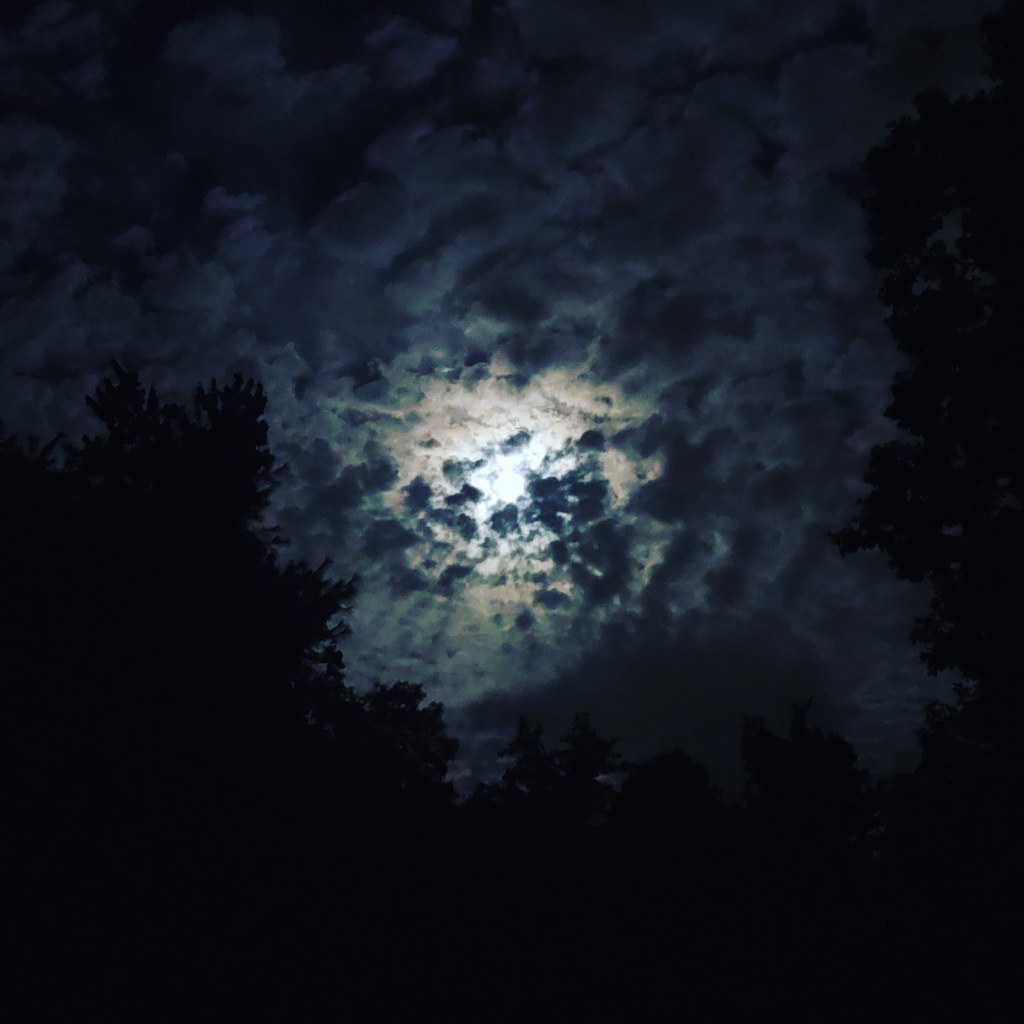
I love stepping outside when the sky is dark and the stars are twinkling. The moon may or may not be in the sky, depending on the phase. That first look at the night sky always takes my breath away. I love to gaze at the stars, imagining what they look like up close and if they communicate with each other. The wonder of it all is awe-inspiring to me. We on Earth are but a grain of sand in a vast, infinite universe where the possibilities are endless.
After being out there for a little while, I begin to focus. My breathing becomes steady and measured. My third eye awakens, and my body begins to tingle. Often, the words roll off my tongue and flows like a river. I lift my arms in praise of nature, the moon and stars. I sing a song of love and wonder. I don’t often plan ahead any of the words I speak. They are raw and spontaneous and honest. Sometimes I don’t “feel” in control; the words are coming out of my mouth but I often feel like a vessel or an oracle.
As I speak, the tingle in my body that I felt earlier grows stronger until my whole body is humming with energy. I can feel the energy shift within myself and my surroundings. The sky grows darker, and the moon and stars grow brighter. The creatures of the night may increase their sounds or become still and silent, depending on the time of year. In the winter, there aren’t many animals out in the cold nights. I live in northern New York, and our winters are cold and snowy. I may hear the distant call of an owl during the winter, or a wolf howling. During the summer it’s different. There is a small pond just beyond my backyard, and it is often alive with creatures when it’s warm out. The chatter of the frogs can become very intense, as does the snapping turtles and Canadian geese. Sometimes a soft breeze will rustle the tree limbs of the massive oaks and maples that fill my backyard, whispering their secrets. Lightning bugs will be visible, sometimes dozens at once, when it’s really hot. When this happens, it feels like these wondrous creatures are joining in my chorus of praise. It is an amazing, unifying feeling, and I feel a kinship with the land and those that share it with me.
Whenever I am singing my song of praise and wonder, I acknowledge those creature sounds as the goddess making her presence known. Especially if it was silent before I began. I always get chills down my spine when I am speaking praise of Hekate in the still, silent night and a wolf begins howling in the distance. Sometimes, I will see a shooting star as I am chanting.
When these informal, raw moments occur it is just me and nature. I don’t light a candle, or use any tools or burn incense. I stand barefoot on the earth and ground myself, and I always touch the ground when I am finished and return that energy I raised to the earth. Often, my dreams that night may be very vivid and I keep a dream journal to record them.
Reading that excerpt from “Drawing Down the Moon” inspired me to share my experiences with bare-bones rituals that can be done literally anywhere and any time you are moved to do so. Connecting to nature this way is so raw and primal and empowering and at the same time intimate. I hope that you may be moved to try this as well whenever the opportunity presents itself.
☆☆☆
Source:
Adler, Margot. “Drawing Down the Moon: Revised and Expanded Edition”. Penguin Books. 2006.
The epithet “Soteira” is an important title of Hekate. Soteira means “Savior” and for me personally it is used in conjunction with Hekate’s role as “Cosmic World Soul”. An excellent book to read from scholar Sarah Iles Johnston titled “Hekate Soteira” delves into Hekate’s role as Savior and Cosmic World Soul within the Platonic / Chaldean philosophy.
What does “Cosmic World Soul” mean?
In the Chaldean Oracles, Hekate is irrevocably defined as the Cosmic World Soul – the Great Mother, the Anima Mundi, Creatrix of All. The source of primordial fire.
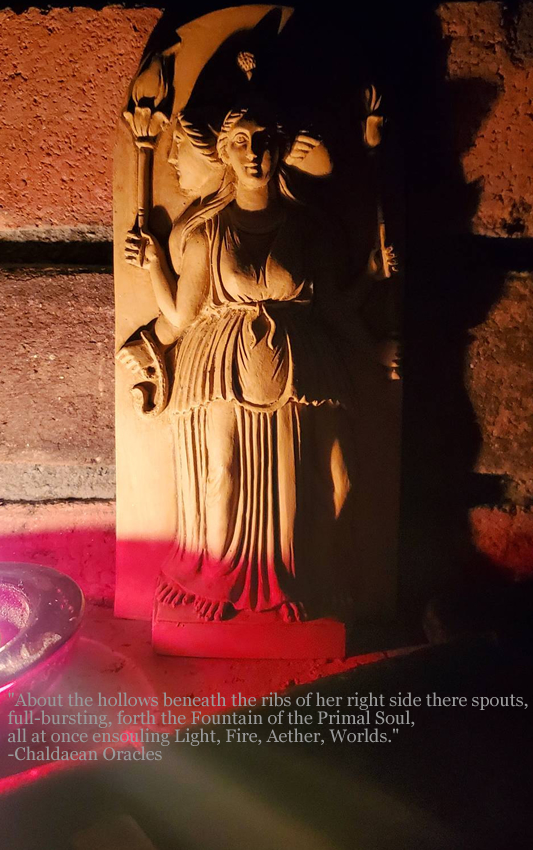
I have experienced many different sides to Hekate over the years, but the one that I “feel” the most is Hekate as this Great Mother; as one who facilitates life, death, rebirth, and everything in between. This excerpt from the Chaldean Oracles sums it up well, and the accompanying text (version from G.R.S. Mead), describes Hekate as “Great Mother/Magna Mater”, “Life of the Universe”, “Mother of Souls”, “Inbreather of Life”.
45
“About the hollows beneath the ribs of her right side there spouts, full-bursting, forth the Fountain of the Primal Soul, all at once ensouling Light, Fire, Aether, Worlds.”
47
“After the Father’s Thinkings, you must know, I, the Soul, dwell, making all things to live by Heat.”
In the Chaldean Oracles, the “Father” is described as existing as intellect or pure thought, while Hekate, as the Anima Mundi, puts forth his thoughts through creation.
During my personal devotionals, I often feel Hekate’s presence as this warm, glowing light. It’s hard to describe – but I when I feel Her presence in this way, I feel an abundance of Love. It is so pure; it’s hard to put into words. There were a few times where I actually witnessed a warm, golden glow appear around me. It is a very emotional and powerful experience; and very real. It doesn’t always happen. But when it does, I will most definitely bask in this sacred glow and honor Her radiance.
The ancient Greek community of Selinunte was founded as a sub-colony of Megara Iblea in 651-650 BCE. One of the first sacred sites in the western Sicilian city, which is considered one of the world’s largest archaeological zones, is the Santuario della Malophoros or the Sanctuary of the Fruit Bearer. “Malophoros” implies pomegranates or apples, […]
Today is September 22, 2020, and once again the Autumn Equinox is upon us. I love the changing of the seasons; I am blessed to live in an area where these changes are very much felt and seen. Autumn is my favorite time of year; it marks the beginning of the Season of the Witch. I love observing nature’s changes during this time: frosty mornings, leaves changing colors, squirrels hoarding acorns, spiders spinning their massive webs outside… my love for this time of year is endless.
The Equinox is the seasonal tide that brings balance, and reflection. We are reaping the last of our harvests from the summer growing season, and preparing for the winter ahead. Our own backyard vegetable garden actually saw it’s last harvest about a week ago, and we are prepping for what may be a long, cold winter here in Upstate New York. Today is a balance of light and dark, and I eagerly await the longer nights and shorter days. I love cocooning myself in the dark and nurturing my inner self. Samhain marks the Witches New Year, and today’s ever important seasonal change before then is a day for reflection on the days past. We traditionally use this time to look back on the last several months and celebrate and give thanks for our blessings, and we mourn what we lost. We try to balance those energies and feelings in order to harmonize ourselves and use those energies in the coming year.
The events of this year thus far has thrown the world into UNbalance, and right now I am feeling anything but balanced. I’m sure many feel the same. COVID took over the world, and threw us into a state of fear, despair, and hopelessness. We saw millions fall ill, nearly 1 million tragically die worldwide, millions more economically impacted by the pandemic. However, what we also saw were countless heroes in our communities helping anyone they were able to help whether it was financial or health assistance, or some form of community outreach. My own community formed groups to help homebound/vulnerable people go grocery shopping or otherwise help them with daily tasks that they were unable to do on their own. We saw birthday parades for children in our town, drive through graduation celebrations for our high school and college graduates. I spent much time searching for positive news stories during this dark time and learned that communities across the US and abroad came together in very similar ways and it was very uplifting to my soul.
Here in the U.S., we are in the middle of a volatile presidential election season. I have never witnessed anything like this in my life. We are literally fighting for the soul of this nation right now, and the stress of this fight is sometimes too much to bear. I fear for our future. The Trump administration has systematically destroyed our democracy and rule of law by bypassing checks and balances within our own government that is supposed to protect this nation from an UNbalance of Power. With the devastating death of Justice Ruth Bader Ginsburg a few days ago, the stakes were raised exponentially and we are now in a fight for our lives. The future of health care, women’s rights, LGBTQ rights are in the crosshairs. A third Trump-appointed Supreme Court Justice threatens to undo much of the progress this nation has made in the aforementioned areas.
My resolve to fight has only grown stronger. My daughters and son have also taken up this fight for our nation. My older daughter will be a first-time voter this year, and I cannot wait to take her to her first presidential election to cast her ballot for our country’s future. We will be voting in person together.
The turmoil of this election season is unlike anything I’ve seen, and I am trying to find balance. It’s not easy, but, I am discovering that it can be done. I’m learning to take my anger, stress, and grief and transmute those emotions into a force for positive change. Social media is one tool for wider community outreach, but nothing beats getting out in your community and engaging with people in your area. I’ve learned that our youth is very invested in this election, and they are our future. They are so intelligent and engaged and seeing their passion gives me hope. As many of us witnessed the complete lack of accountability in our governing body & Department of Justice with regards to rampant corruption in the office of the President, we must collectively take up this fight and mobilize every American who is able to vote and hope that our efforts will be successful.
🗝
In the midst of all this, I am always ever reminded that Hekate is a Goddess of Transformation and Change. She is there, facilitating and observing. It is very difficult for a devotee of Hekate to not be politically engaged, especially now in these tumultuous times. Human rights are always at the forefront. Being a voice for the voiceless. Being an Ally. Being an advocate for those who are unable to take up their fight by themselves. Fighting for what is fair and just, taking special care of those that society deems “unworthy” due to their own prejudices. Sometimes, “tearing that shit down” is the only way forward.
Locri was a Greek colony of Magna Graecia, located in the Calabria region of southern Italy. Locri was the site of a great sanctuary to Persephone – worshipped as a protectress of fertile marriage. Pinakes (or plaques) unearthed at this site depict Persephone as “Queen of the Dead”, residing in Hades. Hundreds of votives, plaques, and other artifacts were found in the temple remains, dating back to about the 5th century BCE. The images depicted on these items tell Persephone’s story as it is described in the Homeric Hymn to Demeter and Eleusinian Mysteries, including pottery tablets depicted Persephone and Hades, sitting side by side on their thrones as King and Queen of the Underworld.
The sanctuary dedicated to Persephone in Locri (also known as Locri Epizefiri) was described by Diodorus Siculus as one of the most famous of the sanctuaries in Magna Graecia. Persephone’s temple featured a propylaia, and possibly had underground rooms for chthonic rites. Based on archaeological findings, it is believed that the Eleusinian Mysteries were re-enacted here.
Outside the temple walls was another location for rituals – the Cave of the Nymphs, also known as the Grotta Caruso. Here, women would undergo katabasis (underworld journey); caves are a common location for rituals involving chthonic deities. Excavations of this site revealed stairs leading down into a subterranean area containing a natural spring basin used for ritual bathing, complete with an altar. Niches were set into the walls for votive offerings. Some of the votives uncovered included figurines of women, many of which were triple-headed (triform).
A very interesting archaeological find was discovered within Persephone’s temple – a pinake of a winged female daimon. This brings to mind the earlier mention of Angelos – the winged messenger/angelic chthonic deity who is identified with both Hekate and Artemis. Winged deities who travel between the worlds are typically messengers or guides of the dead and departed souls.
Temple of Persephone remains at Locri – from Wikimedia
I hope you enjoyed this essay on Hekate in Magna Graecia: Locri.