Hekate in Magna Graecia: Enna


Enna

Enna is located in central Sicily, and according to Diodorus Siculus, is the famed mythical location for Persephone’s abduction, which was said to have happened near Lake Pergusa. Enna was one of the most prominent locations in Sicily for Demeter and Persephone’s cult. Near Lake Pergusa is an archaeological site known as Cozzo Matrice, where one will find the remains of a fortified village believed to be dated to about 8000 BCE. Other archaeological remains date back to a little over 2000 years old, and they include a citadel, remains of a necropolis, and remains of a temple to Demeter. Today, the area of Lake Pergusa is home to a park called “Proserpina Park”, named after Persephone (Proserpina or Proserpine is how Persephone was referred to by the Romans). Nearby, the Rocca (or Rocco) di Cerere Geopark is now known as the land that was once consecrated to the chthonian deities of the Eleusinian mysteries, and their power and presence is very much felt to this day.

The story of Persephone’s abduction and Demeter’s subsequent search is recounted in the Homeric Hymn to Demeter, in which Hekate plays a very prominent role. It is also lays the foundation for the Eleusinian Mysteries.

Persephone was picking flowers, when Hades emerged from a nearby cave and stole her away to his realm in the underworld. Hekate and the sun god Helios witnessed this abduction, though Hekate did not see it happen; She only heard Persephone’s cries for help. Demeter wandered all over the earth for Persephone for nine days, and on the tenth day Hekate appeared before Demeter to tell her what She had witnessed, as told in this passage from the Homeric Hymn to Demeter:

“But when the tenth enlightening dawn had come, Hecate, with a torch in her hands, met her, and spoke to her and told her news: “Queenly Demeter, bringer of seasons and giver of good gifts, what god of heaven or what mortal man has rapt away Persephone and pierced with sorrow your dear heart? For I heard her voice, yet saw not with my eyes who it was. But I tell you truly and shortly all I know.”

Together, Demeter and Hekate went to Helios to ask for his help in finding Persephone. Helios told Demeter where her daughter was taken, but also tried to tell her that she should remain where she was. Demeter did not want to accept that, and continued to wander until she ended up at Eleusis, where she decreed that a temple be built in her honor. During this time when Demeter was in despair, the earth and it’s fruits wasted away. Zeus took notice of the suffering of the earth and it’s inhabitants, and arranged for Hermes to mediate between Hades and Demeter for Persephone’s return. Hades agreed, but, tricked Persephone into eating some pomegranate seeds, which then forever bound her to the underworld for part of the year. Persephone and Demeter were reunited, and Hekate joined them in their reunion. From that moment on, Hekate became Persephone’s torch-bearing guide to and from the underworld twice a year. One of Hekate’s epithets is “Propolos”, which means “guide”.  From the Homeric Hymn to Demeter:

Then bright-coiffed Hecate came near to them, and often did she embrace the daughter of holy Demeter: and from that time the lady Hecate was minister and companion to Persephone.”
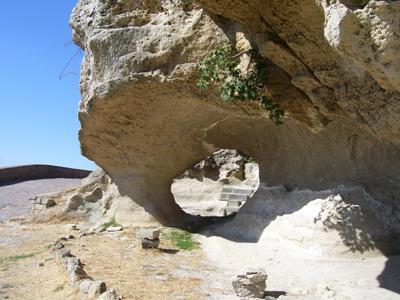
image9

Rocca di Cereri – Enna – from Wikimedia


I hope you enjoyed this essay on Hekate in  Magna Graecia: Enna.

© Melissa McNair / The Torch and Key


Sources:

Hekate in Magna Graecia: Segesta


Segesta

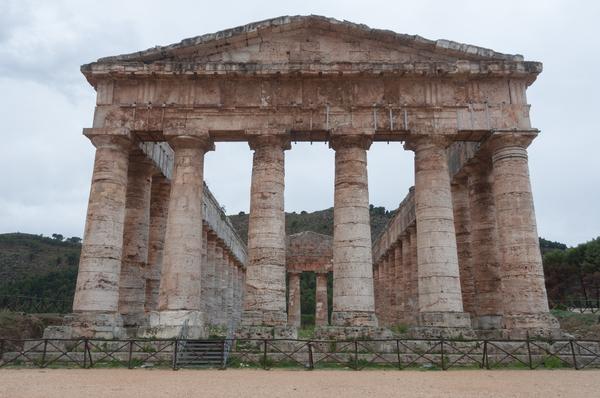
Segesta was a colony located on the northwest coast of Sicily, near current-day Castellamare del Golfo. There is an almost perfectly preserved Doric temple in Segesta, though it was never completed. The temple’s origins are shrouded in mystery; no one can seem to figure out why or for whom it was built.  Segesta was originally settled by the Elymians, believed to be from Anatolia (modern day Turkey), and they arrived in Sicily around 1200 BCE.  Nearby, in Eryx (also known as Erice, also settled by the Elymians), Astarte was worshipped, with a temple dedicated to her in Eryx. Astarte was later conflated with Venus by the Romans; Aphrodite would be the Greek counterpart to Venus. Pottery fragments found in the Segesta area show that they had been engraved with Phoenician and Greek letters and symbols.

Hekate was associated with Aphrodite in a 6th century BCE fragment of Greek lyrics attributed to either Sappho or Alcaeus:

“[Hekate] the golden-shining attendant of Aphrodite.”

The great temple of Aphrodite at Eryx was written about by Strabo and Pausanias, both prominent Greek writers in antiquity.

There is also a traditional Greek amphitheatre in Segesta. Parts of it were decorated with scenes of the nature god Pan, though those images have faded over time. Amazingly, this amphitheatre is still in use today for various outdoor events.

image6

Temple of Venus Erycina – Segesta –  Wikimedia


I hope you enjoyed this essay on Hekate in  Magna Graecia: Segesta.

© Melissa McNair / The Torch and Key


Sources:

Hekate in Magna Graecia: Pachynus


Pachynus / Pakyhnos

According to the Greek poet Lycophron, who lived around the 3rd century BCE, a cult of Hekate was located in Pachynus (Pakhynos), Sicily. Today it is known as Capo Passero, and it is the southernmost tip of Sicily. It is located in the province of Syracuse (Siracusa), a major Greek colony in Magna Graecia and a thriving city today. Nearby, there is the small town of Pachino, which is home to an archaeological park containing temple remains to Apollo and others of unknown origin (this area will be researched further at a later time).

According to Lycophron, Odysseus erected a temple (or a shrine or monument of some sort) in honor of Hekate in Pachynus to appease the spirit of Hecuba:

“O mother, O unhappy mother! thy fame, too, shall not be unknown, but the maiden daughter of Perseus, Triform Brimo, shall make thee her attendant, terrifying with thy baying in the night all mortals who worship not with torches the images of the Zerynthian queen of Strymon, appeasing the goddess of Pherae with sacrifice. And the island spur of Pachynus shall hold thine awful cenotaph, piled by the hands of thy master, prompted by dreams when thou hast gotten the rites of death in front of the streams of Helorus. He shall pour on the shore offerings for thee, unhappy one, fearing the anger of the three-necked goddess, for that he shall hurl the first stone at thy stoning and begin the dark sacrifice to Hades.” (Lycophron’s Alexandra)

The above excerpt has some very interesting points. Hekate, according to Hesiod’s Theogony, is the daughter of Perses (and Asteria). Hekate is also known by the epithets “Hekate Triformis” (triple-formed) and “Hekate Brimo” (angry or terrible one). Hekate also had a known cult in Zerynthia, Samothrace (Greece). The mention of Helorus is most curious, though. Helorus is a river, but it is also a village next to or very close to Pachynus, spoken of by Claudius Ptolemy and alluded to by Pliny. There are archaeological remains of a theater found in Helorus, and there are also remains of a monument built with large stones and placed atop a square pedestal. The remains of this very curious monument may be found between the theater remains and the sea. There is a mystery surrounding this monument, as no one has been able to positively determine who built it or why.


I hope you enjoyed this essay on Hekate in  Magna Graecia: Pachynus.

© Melissa McNair / The Torch and Key


Sources:

Hekate in Magna Graecia: Akrai


Akrai

Akrai was a colony located in the province of Syracuse in Sicily (in or near modern-day Palozzolo Acreide). The ancient ruins of this once-thriving colony are now part of an archaeological park and are home to many important archaeological remains.

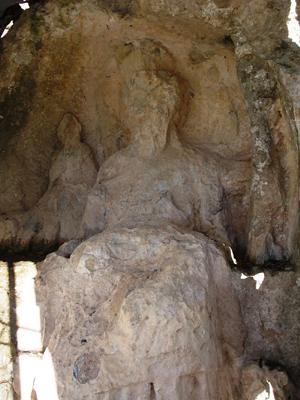
One of the most notable remains of this area are that of the temple remains dedicated to the cult of “Magna Mater”, Latin for “Great Mother”, dated to approximately 4th or 3rd  century BCE. There, you will find the Santoni, a great collection of carved statues set into a rock face near this temple. There are twelve large reliefs; eleven of them depict a seated/enthroned woman, surrounded by other figures. The twelfth carving, found on the level beneath the one containing the eleven seated representations, is a life size depiction of a woman standing. All of these are believed to be Cybele. In all of these carvings, Cybele is depicted with lions. Some of the carved images show Cybele holding offering bowls or drums/tambourines.

In the carvings of the enthroned Cybele, she is depicted with other deities, including Hekate, Hermes and the Korybantes, among others. Hekate and Hermes are closely linked as they are both “Psychopomps” (guides of souls) and are known to guard roadways/travelers. Most curious is the inclusion of the Korybantes; their counterparts are known as the Kouretes/Kharites – nine dancers known to venerate Rhea. Interestingly, there is a 3rd century BCE Attic statue depicting a triple-bodied Hekate surrounded by the Kharites holding hands. This statue is known as a “Hekataion”; triple-bodied Hekate is against a central column with the Kharites surrounding Her. This statue is currently in the Glyptothek Museum in Munich, Germany.

In the Santoni relief carving that includes Hekate, She is carrying what is believed to be a long torch in one hand. This carving connects to another relief depicting Cybele, Hekate, and Hermes together. Demeter and Persephone are also believed to be depicted among the various Santoni reliefs.

The Santoni are found before the Templi Ferali, otherwise known as the “Feral Temples”, dedicated to chthonian deities. It is also believed that the great temple for the cult of Magna Mater is dedicated to Cybele, a great mother Goddess with Anatolian origins. Her Greek counterpart is Rhea. It is widely known that Hekate and Rhea/Cybele are very closely related. Hekate and Cybele are believed to be Anatolian in origin, and both have been depicted with lions. Hekate’s temple in Lagina had friezes depicting Her flanked by lions. Hekate’s association with lions is also documented in the Greek Magical Papyri (also known as the PGM) in the “Prayer to Selene for any spell”, PGM IV.2811-12. In the Chaldean Oracles, Hekate is described as appearing in lion form.

The Feral Temples also was a place for honoring the dead, in conjunction with chthonian deities. The stone walls are filled with niches to hold votive offerings. Nearby, there are stone grottoes containing dozens of oval shaped tombs. Other archaeological finds at this site include painted plaques, pottery lamps, and libation bowls.

As with many ancient cults, not much information is known about the cult of Magna Mater in Akrai. All that remains are the archaeological finds that lends some clues as to the purpose of the temple sanctuary. Akrai is also home to remains of temples belonging to Aphrodite, Artemis, and Kore-Persephone.

image7

Cybele – Temple of Magna Mater at Akrai – from Wikimedia


I hope you enjoyed this essay on Hekate in  Magna Graecia: Akrai.

© Melissa McNair / The Torch and Key


Sources:

Hekate in Magna Graecia: Syracuse


Syracuse/Siracusa

Syracuse (also known as Siracusa) was a major Greek colony on the southeast coast of Sicily. One of Hekate’s connections to Syracuse is through the goddess Artemis. Artemis was worshipped at Syracuse under the cult title of Artemis Angelos. “Angelos” is a title or epithet meaning “messenger” (or “angel”).  In Greek mythology, Angelos was the daughter of Zeus and Hera who eventually became a chthonic goddess. Writer Sophron explains:

“Angelos was raised by nymphs to whose care her father had entrusted her. One day she stole her mother Hera’s anointments and gave them away to Europe. To escape Hera’s wrath, she had to hide first in the house of a woman in labor, and next among people who were carrying a dead man. Hera eventually ceased from prosecuting her, and Zeus ordered the Cabeiroi to cleanse Angelos. They performed the purification rite in the waters of the Acherusia Lake in the Underworld. Consequently, she received the world of the dead as her realm of influence, and was assigned an epithet katachthonia (“she of the underworld”)

The title “Angelos” is also associated with Hekate; a votive found among the archaeological remains at the Temple of Demeter Malophoros in Selinunte was inscribed with Hekate’s name along with the title “Angelos”. References to Hekate bearing the title “Angelos” may also be found in the Chaldean Oracles and the Greek Magical Papyri (PGM). There are some spells in the PGM that call for Hekate’s aid, in addition to Her angelic assistants.

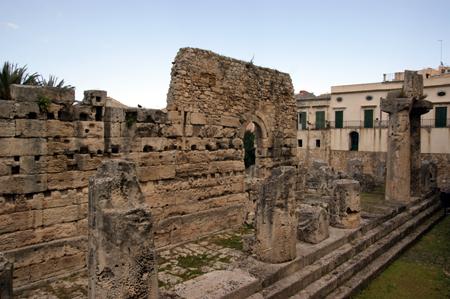
There are remains of the Temple of Apollo in Syracuse, and this temple was also attributed to Artemis. The temple was later converted to a Byzantine church; then converted to a mosque; then again reverted to a church; and it is now, sadly, in ruins.

image4

Temple of Apollo/Artemis – Syracuse – from Wikimedia

Syracuse is also another location  where the Thesmophoria, a female-centered rite in honor of Demeter and Persephone, had taken place, as well Eleusinian rites. According to mythology, Syracuse is linked to these mysteries via the nymph/Nereid Arethusa (daughter of Nereus). Arethusa fled from her home in Arcadia; The goddess Artemis transformed Arethusa into a stream when trying to flee the river god Alpheus. According to myth, she traveled underneath the sea and emerged as a fountain in Ortygia.

While Demeter was searching for Persephone after her abduction, Arethusa pleaded with her to end her punishment of Sicily:

“Then that fair Nympha [Arethusa] whom once Alpheus loved rose from her pool and brushed back from her brow her loved dripping hair, and said: world hast sought thy child, mother of crops and harvest, ‘O thou, divine Mother, who through the cease at last thy boundless toil and end they savage rage against land that has kept faith with thee. The land is innocent; the against its will it opened for that rape. Nor is it mine, this land I for–I, a stranger here. My land is Pisa and plead I trace my stock from Elis [in Greece]. Here in Sicania (Sicily) I dwell an alien, but in all the world is dearer now to me. I, Arethusa, have no land here my home, my heart. This land, I pray, goddess most cherish and preserve. Why I forsook my home and fared so gentle, far ocome to tell, when cares are lightened and thine eyes are ‘er the vast ocean to Ortygia, a fitting time will bright. The earth opened a way for me and I was borne deepest caverns, until here I raised my head and saw the below its stars again. And so it was that, while beneath the earth I my Stygian stream, I saw, myself with my own eyes, glided in your Proserpina [Persephone]. Her looks were sad, and fear still in and yet a queen, and yet of that dark land Empress, and yet her eyes; with power and majesty the consort of the Sovereign lord of Hell.” – Ovid, Metamorphoses

Hekate always plays a part in rites honoring Demeter and Persephone; she was one of the first to hear Persephone’s cries as she was abducted, and Hekate was her guide during her travels to and from the Underworld.


I hope you enjoyed this essay on Hekate in  Magna Graecia: Syracuse.

© Melissa McNair / The Torch and Key


Sources:

  • Fischer-Hansen, Tobias (editor). Poulson, Birte (editor). From Artemis to Diana: Goddess of Man and Beast (Acta Hyperborea). Denmark: Museum Tusculanum Press, 2009
  • “Angelos (mythology)”, https://en.wikipedia.org/wiki/Angelos_(mythology)
  • Farnell, Lewis Richard. The Cults of the Greek States Vol. 2.  London: Oxford University Press, 1896
  • Fischer-Hansen, Tobias (editor). Poulson, Birte (editor). From Artemis to Diana: Goddess of Man and Beast (Acta Hyperborea). Denmark: Museum Tusculanum Press, 2009
  • Mead, G.R.S. Chaldean Oracles Vol. 2. London: The Theosophical Publishing Society, 1908
  • Betz, Hans Dieter. The Greek Magical Papyri in Translation. London: The University of Chicago Press, 1996
  • “Temple of Apollo, Siracusa”, http://www.sacred-destinations.com/italy/siracusa-temple-of-apollo
  • “Arethusa (mythology)”,  https://en.wikipedia.org/wiki/Arethusa_(mythology)


Hekate in Magna Graecia: Akragas / Agrigento


Agrigento/Akragas

Another major area that was settled by the Greeks in Sicily is Agrigento (also known as Akragas or Agrigentum), and the area is named “Valley of the Temples” due to the many temples that have remains in this area. The Valley of the Temples is a major tourist destination, attracting visitors from all over the world.

Agrigento was a very prosperous city, which rivaled that of Syracuse’s power and prosperity. Agrigento is located on the southern coast of Sicily, situated between two rivers. This area boasts many temples, including temples to Zeus, Hera, Heracles, Concordia (one of the best preserved temples in Magna Graecia), Castor and Pollux (the Dioscuri), Hephaestus, Isis, Asclepius, Athena, and of course – Demeter and Persephone, which was part of a temple to Chthonic deities.

The temple in Agrigento dedicated to chthonic deities, namely Demeter and Persephone, will also include Hekate, though Hekate’s associations may be a bit obscure. This trio of goddesses was frequently worshipped together due to their Eleusinian connections.

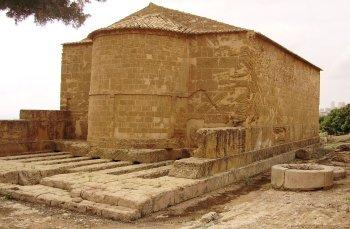
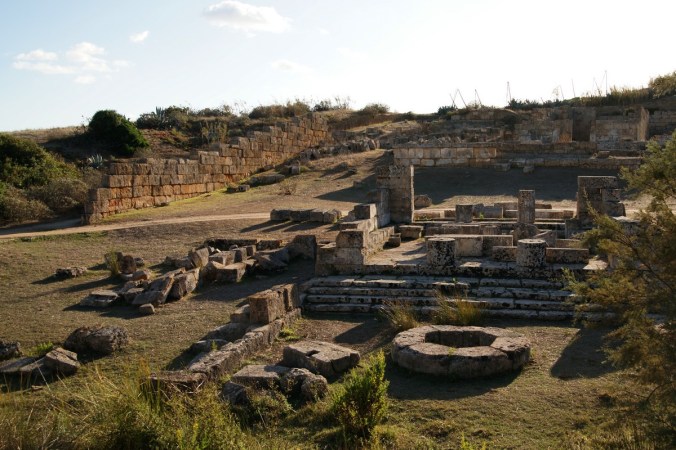
Today, the temple itself is actually partially buried under ground, with the church of San Biagio now standing above it. San Biagio – how he is known in Italy – is in other areas of Europe known by the name of Saint Blaise, and was known for being a “physician of souls”. Curiously, icons representing Saint Blaise depict him bearing two crossed candles. Other icons representing him show him in a cave surrounded by wild beasts. His feast day falls on February 3rd, the day after Candlemas (also known as Imbolc). Some areas of Europe also honor him on Candlemas itself. Hekate, as it is known, is most often depicted carrying a torch in each hand and is sometimes celebrated on Imbolc, due to Her epithet of “Phosphorus”, which means “light-bearer” or “light-bringer”.

The remains of Demeter’s temple dates back to approximately 470 BCE. The base of the original structure of the temple is still preserved and partly visible, and it measures approximately 30 by 13 meters. Other remaining, visible parts of this temple have been incorporated into the church, such as water spouts in the shape of lions’ heads that can still be seen today. Some of these may be found in the regional Agrigento museum. If you are familiar with the Chaldean Oracles, then this piece of architecture would be of great interest, as Hekate was said to at times appear in “lion form” in the Oracles. Other interesting archaeological finds from this temple include ritual vessels (kernoi) linked to Persephone (likely used for offerings), remains of oil lamps used for ritual processions, and remains of stone busts possibly depicting Demeter, though that has not been confirmed to indeed be Demeter.

Next to the Temple of Demeter, you will find a series of connected caves used for ritual purposes. The walls of this subterranean complex contain grooves for holding ritual offerings and votive statues. A connecting rock wall between the caves reveals an aqueduct, utilizing the natural underground waterway found there. This is an exciting find, because this ritual cave complex is believed to have been connected to Demeter’s temple and would likely have been considered a “gateway to the underworld”, similar to other temple sanctuaries found in Greece, most notably Eleusis itself. It is known that many cults belonging to Hekate in Greece used caves for rituals honoring Her, such as the Zerynthian caves in Samothrace.

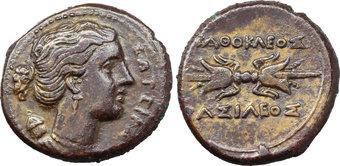
Separately from Demeter, it is believed that Artemis was worshiped in Akragas as “Artemis Soteira”. “Soteira” is another epithet belonging to Hekate and means “savior”. Hekate is referenced as savior in the Chaldean Oracles and Sarah Iles Johnston has devoted an entire book on the subject, titled Hekate Soteira: A Study of Hekate’s Roles in the Chaldean Oracles and Related Literature. 3rd century coins depicting the head of Artemis as “Soteira” have been found.

Hekate and Artemis do share a couple of other epithets, including “Phosphoros” (“light-bearer” or “light-bringer”); “Propylaia” (“at the gate” or “before the gate”).

image2

Agrigento – Church of San Biagio on foundation of the Temple of Demeter – Wikimedia

image5

3rd century BCE coin depicting Artemis Soteira, found in Akragas


I hope you enjoyed this essay on Hekate in  Magna Graecia: Akragas/Agrigento.

© Melissa McNair / The Torch and Key


Sources:

Hekate in Magna Graecia: Selinunte

Selinunte

Selinunte (also known as Selinus or Selinous) was a major settlement on the southwest coast of Sicily, and was believed to have been settled in the mid-6th century BCE, though the exact date remains unknown. The acropolis of Selinunte was situated between two rivers, and a major sanctuary dedicated to Demeter Malophoros was located there. This sanctuary contained several buildings within it, the largest one being Demeter’s temple. “Malophoros” (or Malophorus) is an epithet meaning “fruit-bearer”, which correlates to Demeter’s role as goddess of fertility and agriculture. The lands surrounding Selinunte were very rich and fertile, perfect for farming. Some interpret the epithet “Malophoros” as meaning either “apple bearer” or “pomegranate bearer”. “Pomegranate bearer” makes sense to me personally, considering the pomegranate fruit featured prominently in the Homeric Hymn to Demeter, which tells the story of the Rites at Eleusis. Persephone, Demeter’s daughter, ate seeds of the pomegranate fruit, which forever bound her to the Underworld.

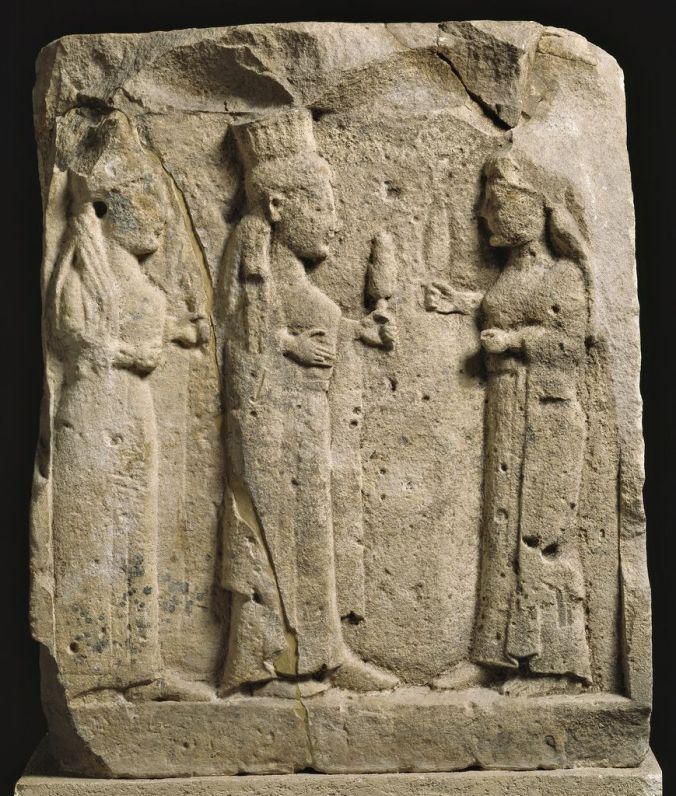
Votive remains depicting Hekate, Demeter, and Persephone together have been found within these sanctuary remains, which is not surprising considering these three goddesses are the focus of the Eleusinian Mysteries, with Persephone’s abduction said to have taken place in Sicily according to various Sicilian cult beliefs. The worship of Hekate, Demeter, and Persephone together in Sicily is a result of Greek migration to this area, and a continuation of religious and ritual practice dating back centuries before.

The temple sanctuary featured a very large altar, stone temenos walls, and a “propylaia”, and this temple is the only one in Sicily that was constructed in such a manner and is believed to pre-date the temple style that features the tall Doric columns. One of Hekate’s many epithets is “Propylaia”, a Greek term which translates to “before the gate”. Hekate is widely known as a liminal Goddess, guarding crossroads, entryways/doorways, and other areas with a defined border, such as where grass meets forest or where sand meets the sea. The enclosed propylon had to be entered from the East, and was dedicated to Hekate, based on engraved votives found in the vicinity.

Sadly, this city was destroyed by the Carthaginians around 400 BCE and was eventually resettled, with the temples being reused. Approximately 12,000 remains of female votive figurines and defixiones (curse tablets) were also recovered in excavations of this site.  These defixiones, often referred to as the “Getty Hexameters”, specifically mention Hekate by name (as well as identifying Her as Enodia), along with Persephone and Demeter. An excerpt of the words on these defixiones describes Hekate as shouting in a terrifying voice, bearing torches:

“…down from the shadowy mountains in a dark gleaming land a child brings from Persephone’s garden for milking, by necessity, the four-footed holy servant of Demeter, a nanny laden with an unceasing flow of rich milk, and she follows, trusting in the bright goddesses…torches, and Hecate Enodia, shouting a foreign-sounding shout in a terrifying voice…”

This temple appears to have been a major worship area for Selinunte, even eclipsing the Temples of Hera and Zeus, also in the same area. Archaeological evidence also suggests that Demeter’s temple was a hub of sorts for funerary rites, which fits with Hekate’s role as Psychopomp (guide of souls) and the reincarnation theme of the Eleusinian Mysteries, with Hekate, Demeter, and Persephone at the center of them.

Many of the archaeological finds from Selinunte are currently housed in the museum in Palermo, Sicily.

Selinunte-demeter-malaphoros

Propylon of Hekate at Temple of Demeter Malophoros – image source: Wikimedia commons

66bdb8310ffb35c600fe4ae90ad55533

Relief of Demeter, Persephone, & Hekate – Selinunte – Palermo Archaeological Museum


I hope you enjoyed this essay on Hekate in  Magna Graecia: Selinunte.

© Melissa McNair / The Torch and Key


Sources:

Hekate in Magna Graecia: An Introduction

Hekate had many cults throughout the ancient Greek and Roman world, scattered between Greece, Italy, Turkey, and possibly beyond. These essays will focus on Her known connections in Magna Graecia, with each month featuring a different colony. But first, a small bit of history.

Magna Graecia was the name given by the Romans to the coastal areas of Southern Italy in the present-day regions of CampaniaApuliaBasilicataCalabria and Sicily. Magna Graecia is Latin for “Great Greece” (Greek: Μεγάλη Ἑλλάς, Megálē Hellás). This area of Southern Italy has a very rich and diverse history. Due to it’s location in the Mediterranean Ocean, it has attracted people from all over the region and the island of Sicily was conquered by many different nations in the past. Many will be surprised to learn that those who are from modern-day Southern Italy/Sicily will have traces of ethnic origins from areas in the Middle East, Turkey, and North Africa.

Greeks began to settle in southern Italy in the 8th and 7th centuries BCE, with the hopes of finding a new life after leaving Greece for various reasons, including famine, new coastal job opportunities, or they were exiled from their homeland. Due to the heavy influx of Greek citizens into Magna Graecia, Hellenic culture quickly followed. Religion, language/dialect, and Greek civilization took root and flourished there. Some major and powerful Hellenic settlements in Magna Graecia included the following locations in Sicily: Segesta (my family is from that region, specifically Scopello and Castellamare del Golfo), Syracuse, Agrigento/Akragas, Selinunte; and in Southern mainland Italy there is Cumae and Kroton – all on or near the coast. Preserved archaeological remains in these cities are a testament to a bygone era of Hellenic civilization in Southern Italy, and to this day they attract thousands of tourists from around the world.

This research is very personal for me; I am a third generation Sicilian-American and my grandparents were born and raised in a small village on the northern coast of Sicily. They are from the region that was Segesta, a major Greek colony belonging to the Elymians, who were one of three indigenous peoples of Sicily. My family began immigrating to America after the end of the Second World War, with many of them arriving by the late 1970s. Most have stayed behind and remain in Sicily today (with some settling on the island of Sardegna).

A bit of a disclaimer before we delve into Hekate’s presence in southern Italy: these essays are by no means exhaustive; there is a lot that remains unknown as to the finer details of cult worship as outlined below. There really isn’t much to go on apart from the archaeological remains that have been found to date and thoroughly examined. Written records are rare; all we have are fragments written by historians from antiquity such as Strabo and Diodorus Siculus (and others). These remains and the scattered written fragments of history are the only clues we have with regards to ritual practices and worship in ancient times. The Eleusinian Mysteries were re-enacted in Sicily after temples and sanctuaries were established for Demeter, Persephone, and Hekate. Cult worship of Demeter and Persephone was widespread across Sicily. Many of you reading this may already know that the Eleusinian Mysteries were highly secretive; participants were sworn to secrecy and were not allowed to discuss the rites with non-initiates, and as a result there is virtually no written record of them.

I have no doubt that there are many areas where archaeological remains in Sicily are buried and have yet to be discovered. I am not a professional scholar; I am just a devotee of Hekate who also honors Demeter and Persephone – the holy triad of the Eleusinian goddesses. Hekate appeared in my life and claimed me in March of 2010, and I have spent much of my time since then researching and studying historical practices as related to them and ancient Hellenic rituals in general. I have devoted a good portion of that time studying Hekate’s presence in Magna Graecia; many references to Hekate in this region are, unfortunately, obscure and I did my best to piece together what wasn’t so obvious based on my own knowledge and other historical data. My hope is that these essays will light a fire within you and inspire you to explore these ancient sites in Sicily and southern Italy and beyond, and to try and piece together Hekate’s living history of worship. Hekate is a multi-faceted goddess who transcends cultures and geographical locations.

Editorial note: throughout these essays I often refer to Hekate using the pronouns “She” or “Her”. I have written these words beginning with a capital letter as a sign of honor and respect.

The February essay that will be shared will discuss the remains found in the colony of Selinunte, located on the southwest coast of Sicily. I do hope that you will find these essays informative and enjoyable. If you would like notifications of new posts, be sure to subscribe to my blog either directly through WordPress if you have an account, or via email (both subscribe options may be found on the blog home page).


© Melissa McNair / The Torch and Key. All rights reserved.